Training at Home
While panic settles in around us and some people prepare to trade their soul for a roll of toilet paper, climbers — those famously un-self-absorbed creatures — are wondering whether they should still be whistling their way to the crag. They wait to see the official recommendations, change their minds ten thousand times, and eventually conclude that if people are getting this angry at each other on social media, the situation must be serious.
So, lacking a satisfying virtual-reality climbing app, we’re left wondering how to hold onto the progress we made during our few months of hibernation at the gym.
Since self-isolation started, plenty of climbing-specific coaches have shared simplified strength and conditioning programmes to make up for the lack of gym time. The wiser among us will have taken a few well-earned rest days after winter training before diving headlong into whichever programme our favourite climbing YouTuber put forward.
Now that those rest days are nearly over, it’s time to try to structure our efforts for the best result we can get. With the flood of information now available everywhere on the subject, the choice can get overwhelming fast.
Choosing your exercises
It comes down to keeping the finger work simple and in line with the cycle you’re in and the goals ahead of you, while varying the type of routine from time to time. And above all, don’t forget to do complementary strength work that’s as specific as possible to your objectives.
Guided workouts online are useful for holding onto general fitness, but it’s important to try to recreate positions as close as possible to the ones our sport actually demands.
For some, the temptation will be strong to replace the volume of climbing we normally do — often enormous — with hangs. Remember that if your body isn’t already used to that kind of effort, it’s especially important not to get carried away and grind out endless strength work on your board.
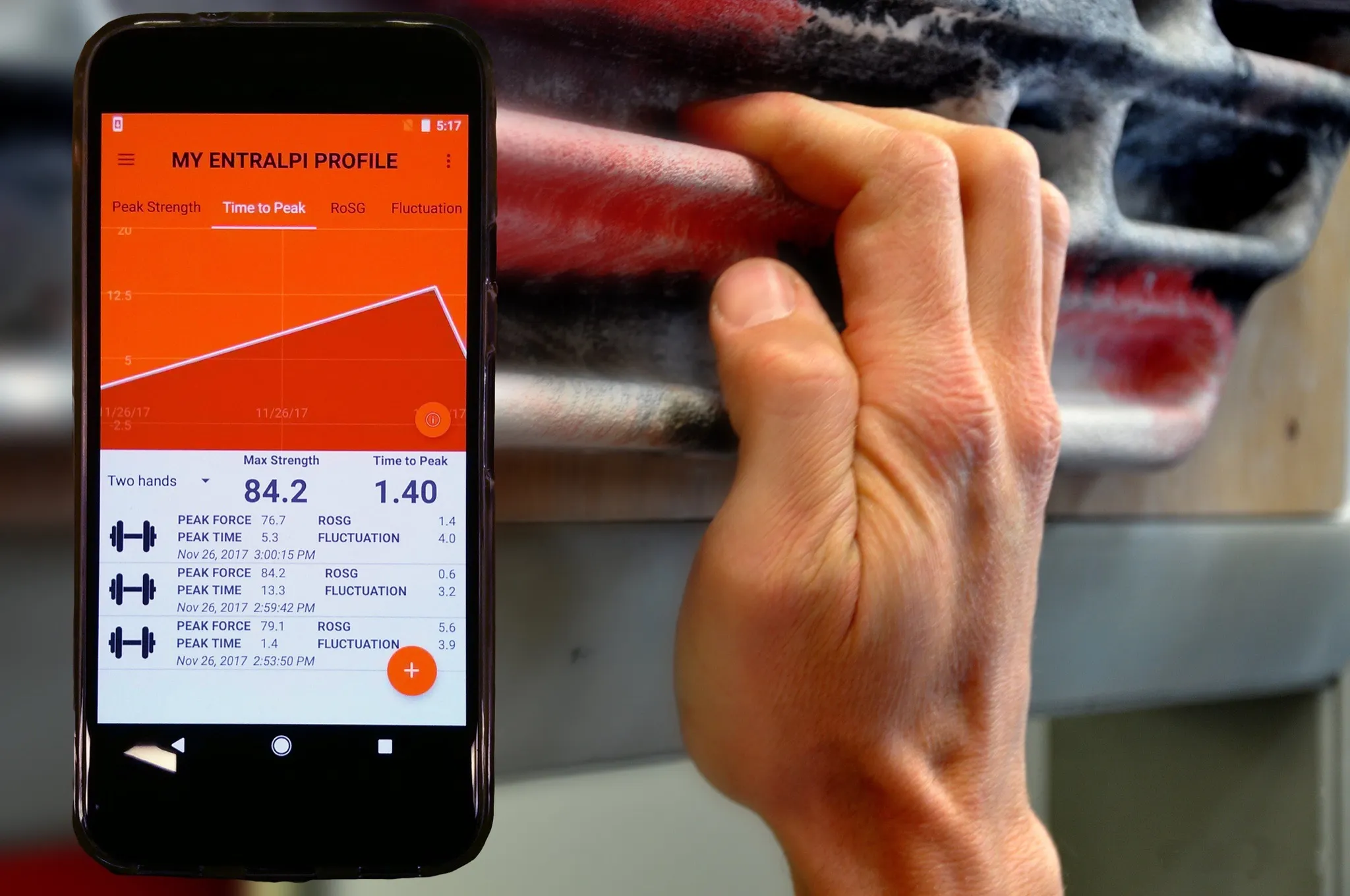
With Entralpi it’s straightforward to control the type of contraction you want to target. Start by simply finding the maximum force you can apply on a given hold with a given grip. Then, by setting factors like the percentage of your maximum and the duration of the effort on that hold, you can decide which energy system to aim at for the session.
A concrete application
Here’s the finger work I’m doing at the moment. The hang times are set according to my goals and my style of climbing, which is fairly fast.
Strength
For this system I usually use voluntary contractions up to 90% of my maximum for around 7 seconds, depending on the kind of project I have in mind, with rests of at least 2 minutes. These aren’t normally long sessions, and they repeat about twice a week.
Contact strength
I work this immediately after the strength training. The objective is finger power: deploying high-intensity contractions very quickly and holding for about 1 second. This method is for people with solid hanging experience, and it tries to recreate the effort of a campus board or limit bouldering. You do several maximal 1-second contractions with several seconds of rest between each, followed by a rest of at least 2 minutes.
Resistance
For me this means sets of 6 contractions of 7 seconds with 3 seconds of rest, at roughly 65–75% of my maximum. I do several sets — about 6 normally — until performance drops off and I have a good pump. I rarely use this protocol under normal circumstances, but in lockdown it seems to stand in reasonably well for the one route session a week I’d usually do at the gym.
Endurance
For endurance I do 10-second contractions separated by 5-second rests, for 15 minutes, at around 30% of my maximum. This method seems to greatly improve the ability to shake out on holds while climbing. I do this routine almost every day, sometimes several times a day.
This low-intensity, high-volume exercise is ideal on a portable hangboard — a Digitclimbing Yubiboard fixed to the Entralpi plate in a seated position, for example. That way you avoid overtiring your shoulders from too much weekly hanging volume in the same position.
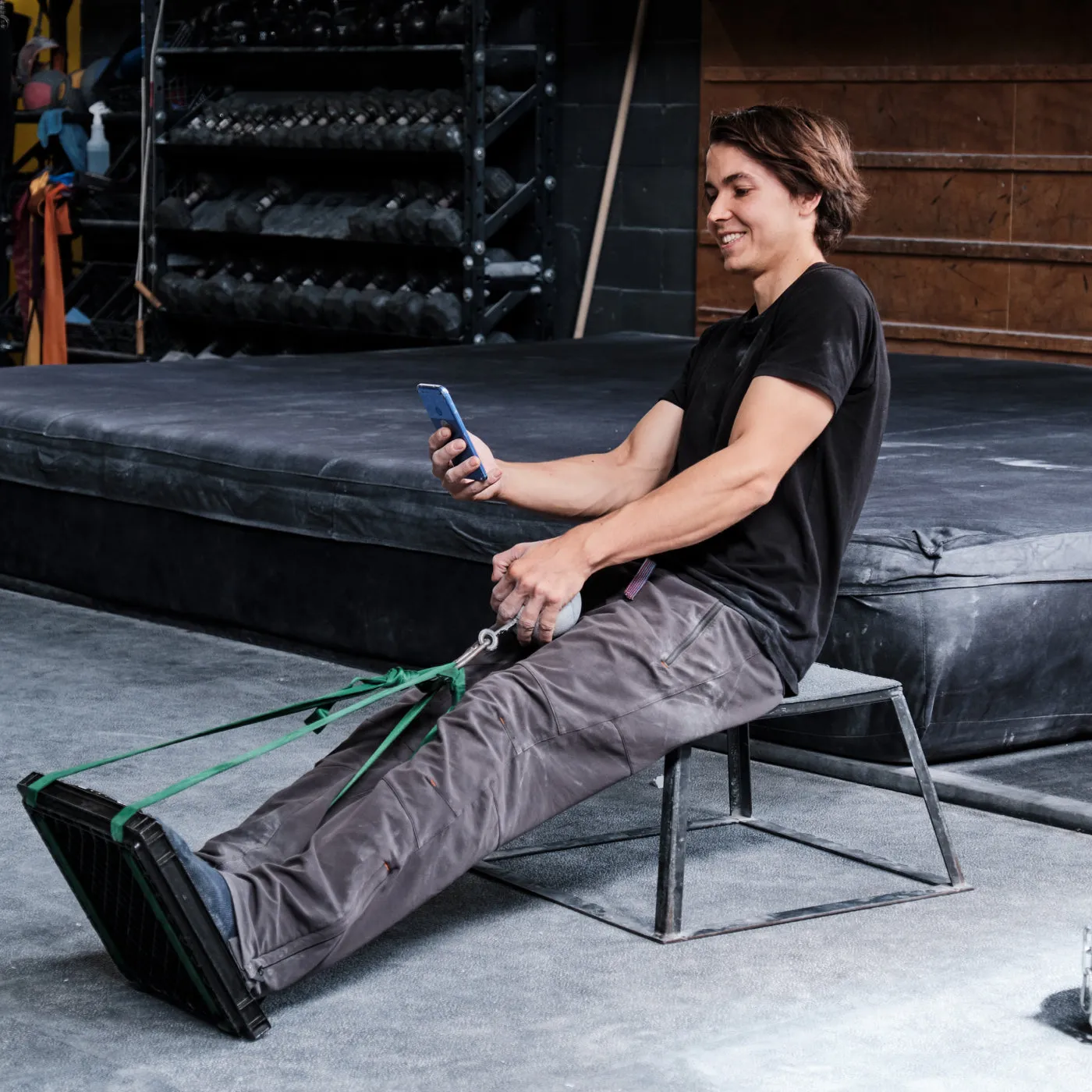
As for how the weeks are organised — for now, given that there’s no climbing — my finger training looks like this:
| Day | Session |
|---|---|
| Saturday | Strength |
| Sunday | Active rest (endurance) |
| Monday | Resistance |
| Tuesday | Active rest (endurance) |
| Wednesday | Strength |
| Thursday | Active rest (endurance) |
| Friday | Full rest |
This example week covers finger training only. Climbing-specific strength work will be the subject of another post.