How to Set Climbing Goals and Plan Training
Updated 6 min read Mind and goals Félicien Roy
On this page
List what you want from the next 6 to 12 months, sort it by priority and define what you expect from each goal. Measure the gap with valid tests, plan training from it, and review the season at the end. This is a coach’s method: research backs specific goals in general, but no trial in climbers has been found.
Félicien Roy holds a master’s in kinesiology from the Université de Montréal and has been training for more than 10 years, as a personal trainer and as an athlete. As of 2021, his ascents include multiple 5.14s and close to a hundred 5.13s.
“No goal is too big. It’s only a question of time, persistence and putting the effort in the right place.”
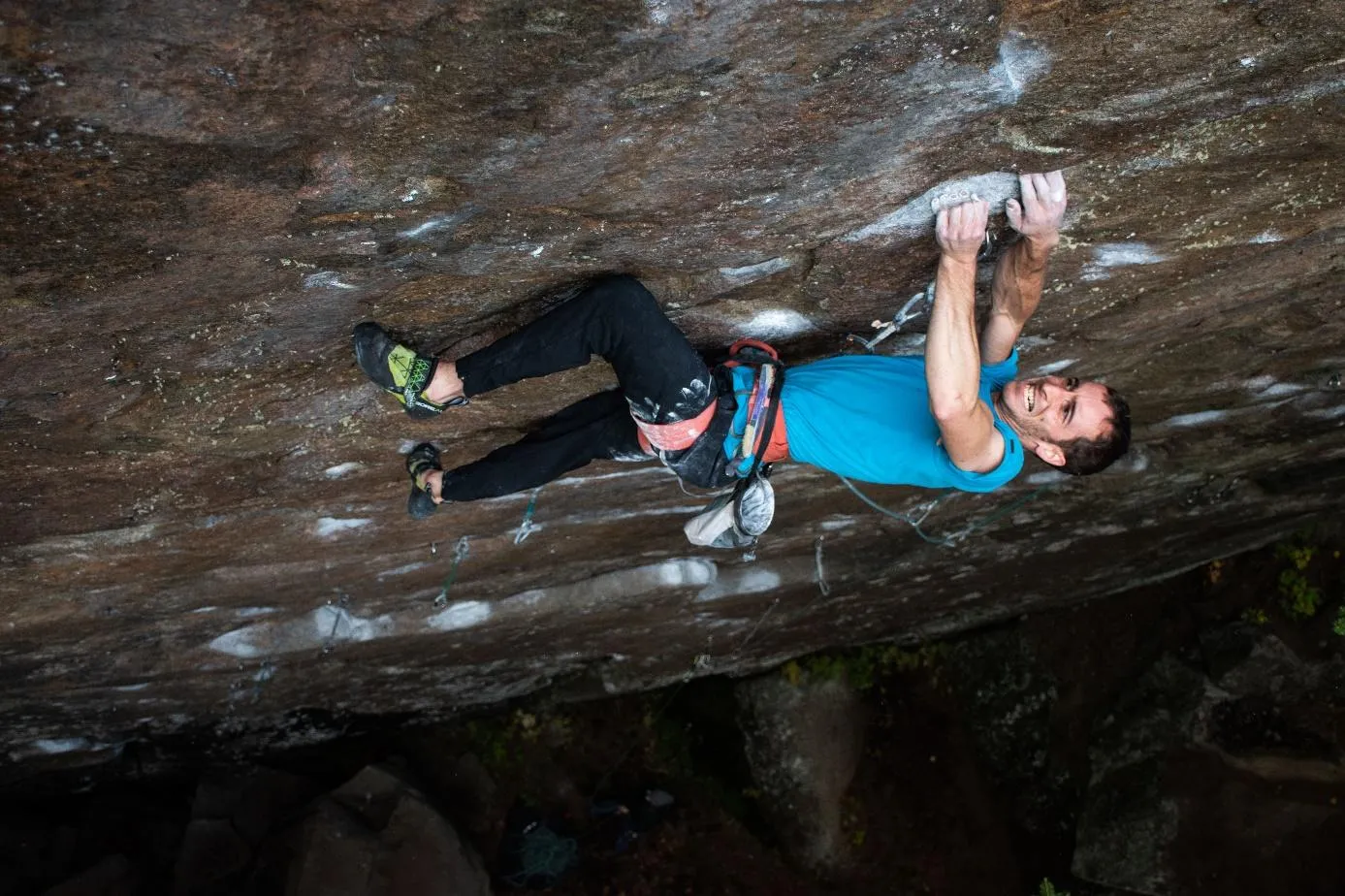
Félicien Roy on Poumon d’acier 5.13d at Sanatorium — photo Amandine Geraud
Training can look like a pile of exercises collected from books, videos and stronger climbers, each tied to the goals of the athlete who uses it. To find exercises that make you progress, identify your own goals. You want to be stronger, of course — but why? By what measure?
How do you work out your goals?
Look far into the future: a minimum of 6 months, ideally a full year. Write down everything that appeals to you and motivates you: competitions, new challenges, ideas and dreams. Check that these are your own dreams, not those of people around you. Treat the list as a draft and come back to it several times. It is the base of the iceberg: every step that follows comes out of it.
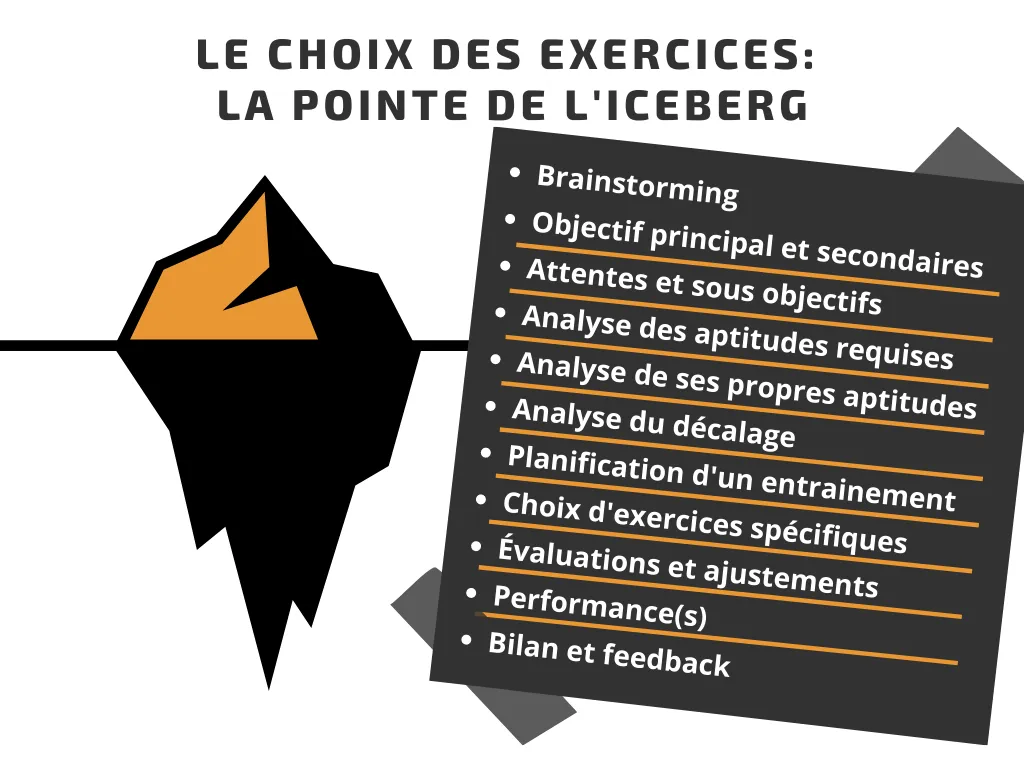
Then sort by priority. We all want to do a million things, and there isn’t time for all of it. Drop the dreams that would demand too many concessions given your current circumstances, so you know where your energy goes first.
My 2020 list in order of importance, after removing a few goals that will come later:
- Livin Astro at Rumney
- A fun trip to Mexico
- The route Sha-sha at Orford
- Discover the climbing at Sanatorium
- Get into trad climbing
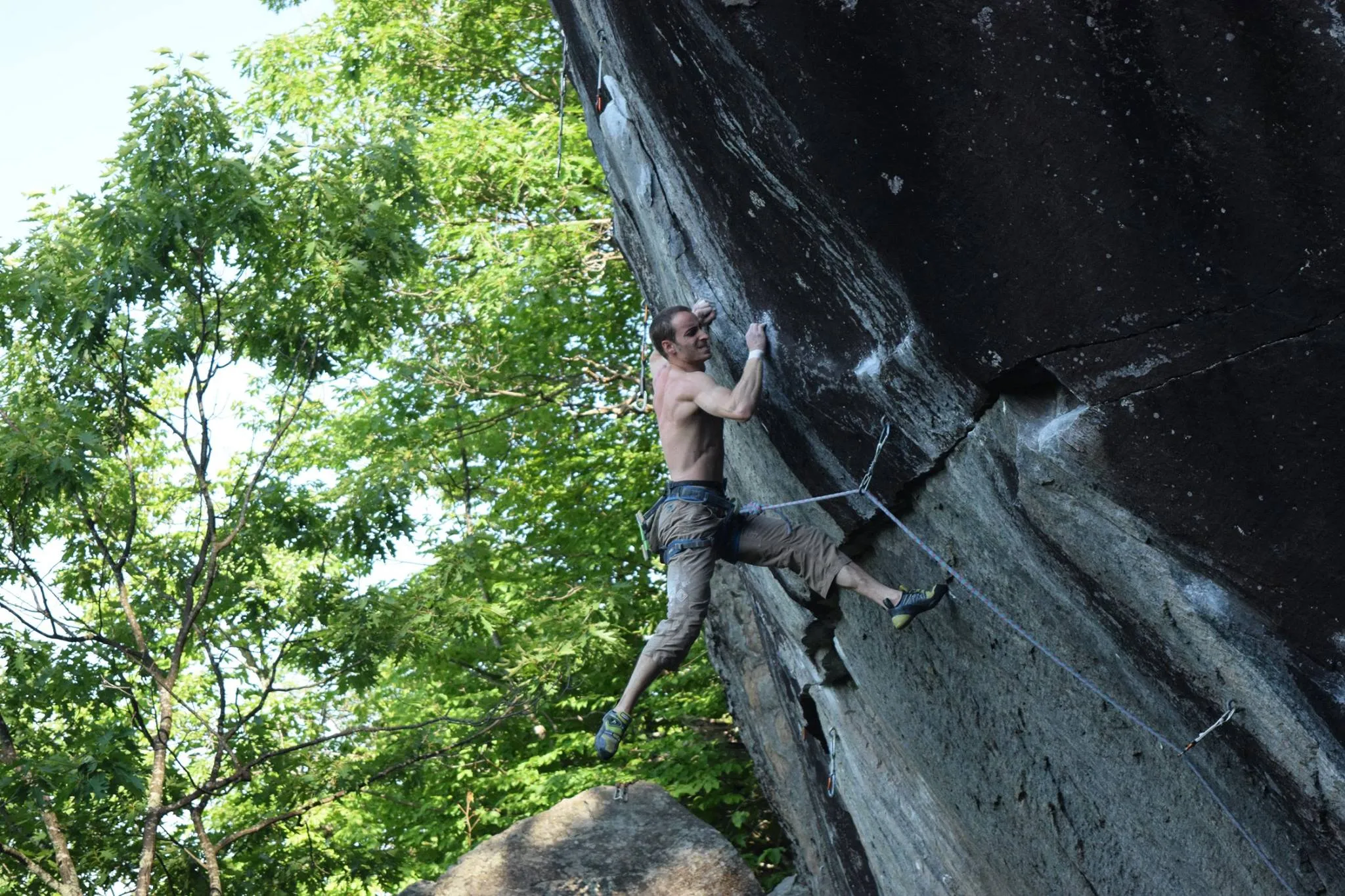
Livin Astro, 5.14c, Rumney
What do you expect from each goal?
The more detailed your expectations, the clearer and more precise the path: you drift off course less, and get back faster when you do. Without clear expectations you can’t know whether you reached your goal, and it’s easy to think you never progress.
Expectations can be qualitative (descriptive) or quantitative (measurable). To my mind the ideal is to combine both. Each expectation then becomes a sub-goal.
My Mexico trip breaks into a week of multipitch at El Potrero and a week of single pitch at El Salto. My expectations:
- Have fun in the middle of the Quebec winter by climbing as many different routes as possible
- Move up the grades progressively on multipitch and do at least one 12a pitch at El Potrero
- Do as many 5.12a-and-up routes as possible at El Salto, and resist the temptation to project hard routes
- Be self-sufficient on multipitch
What the research says: Locke and Latham’s review of 35 years of goal-setting research found that specific, challenging goals lead to better performance than vague ones such as “do your best”. Findings in sport are more mixed (Weinberg, 1994).
How far are you from each goal?
This step is the key one. Work out what each sub-goal requires cognitively, energetically, motor-wise and contextually, and set that against your current training state and your experience. Assess your training state with valid tests, ones you are confident measure the right things. The gap defines what you need to train and how long it will take. For a goal with a fixed date, like a competition, revise the expectations if the gap is too large for the time you have.
What the research says: repeatable finger tests are a good start. In a 2025 study of 307 climbers, maximal finger strength accounted for about two thirds of the variance the tests explained in climbing ability, followed by intermittent finger endurance (Berta et al.). How to test finger strength covers the tests. They do not cover technique, tactics or the mental side, which the gap analysis also needs.
How do you plan the training?
Now you know which strings are missing from your bow. Work on your weaknesses first. Maintain your strengths alongside, with much less time. The classic trap is the reverse: it’s more pleasant to work on what you’re good at, especially when people are watching.
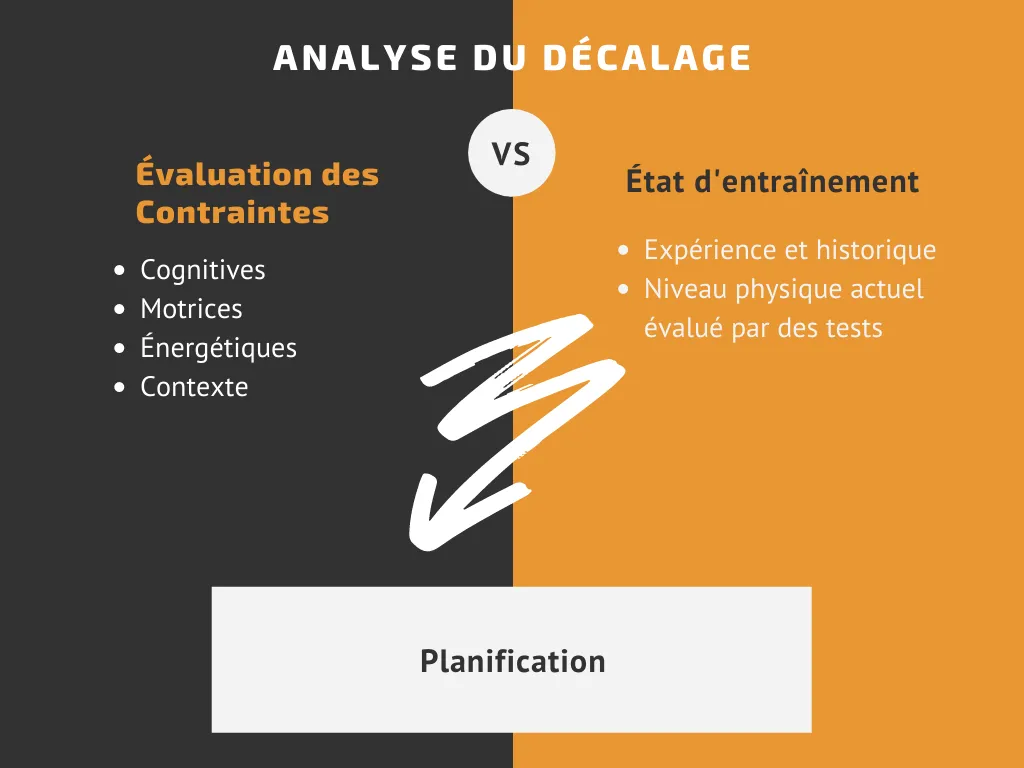
Plan a progressive development of these abilities so you’re ready on the day. Only then choose exercises, each with its sets, repetitions, intensity and pace justified by the plan. (Weaknesses first is Félicien’s approach; no trial testing it has been found. A 2023 meta-analysis did find that finger-flexor resistance training beats climbing alone for finger strength, rate of force development and forearm endurance: Stien et al.) Plan your training turns the plan into a weekly schedule.
Repeat the same tests under identical conditions (warm-up, measuring tool, fatigue state) to measure your rate of progress. Unpredictable events (injury, a pandemic, closed climbing centres) shouldn’t call the goals into question: what changes is the means, and how they are laid out over time.
What do you do on the day, and after?
On the day of an onsight or a trip, set every question about your plan aside. This is the moment to execute and to enjoy it. Don’t doubt what you accomplished in training. Give 100% of what you have, whatever it is you have. The questions come after.
Once the season is over, take stock of the victories and the failures:
- Was each goal and sub-goal reached, nearly reached, or not reached at all? Do you want to keep working on the ones you missed?
- Did you overestimate or underestimate the goals, or your ability to meet them?
- Was the training effective, in the plan, in sticking to it, and in the exercises chosen?
Knowing the why of every session is what gives you the strength to do it. This strategy is the one I use and like; it is certainly not the only one. A kinesiologist or coach can guide you through any of these steps.
Disclosure: when this was written, Félicien was supported by Entralpi, among other sponsors.
The 2020 plan appears to have worked out for Félicien:
- He did his first 13a multipitch at El Potrero Chico — “Time for Livin’” 12b, 12b, 12a, 12c, 13a, 12c — sending every pitch except the last.
- He did 19 routes of 12a and above, including three 5.13s, in 10 days at El Salto.
- With the United States closed, he replaced his Livin Astro 5.14c project with local ascents and managed 9 routes of 5.13d in 6 months.
Editor’s note (Félix Bourassa-Moreau): the “What the research says” notes and the bracketed research comments are mine, not Félicien’s. Where they say no trial has been found, that is the result of my literature search in October 2026.
Sources
- Locke EA, Latham GP (2002). Building a practically useful theory of goal setting and task motivation: a 35-year odyssey. American Psychologist, 57(9).
- Weinberg RS (1994). Goal setting and performance in sport and exercise settings: a synthesis and critique. Medicine & Science in Sports & Exercise.
- Berta P, et al. (2025). Validity and normative scores of finger flexor strength and endurance tests estimated from a large sample of female and male climbers. Journal of Sports Sciences, 43(3).
- Stien N, et al. (2023). Effects of climbing- and resistance-training on climbing-specific performance: a systematic review and meta-analysis. Biology of Sport.
You can reach him @felicienroy on Instagram to find out more about training and his coaching.
Was this helpful?
Thank you. It tells us which articles to improve.
Sorry this did not answer your question. Write to us if you need an answer, or try the search above.
Thank you. It helps us improve this page.