How to Test Finger Strength
Updated 5 min read Testing Félix Bourassa-Moreau
On this page
Start with maximum force: pull as hard as you can for about 5 seconds on a 20 mm edge, three times, and keep the best. Add critical force for endurance and rate of force development for speed when you need them. Keep the edge, grip, device and warm-up the same, and retest every 4 to 8 weeks.
What do the three tests measure?
- Maximum force is the most force your fingers can produce on the edge. It is the main physical predictor of climbing ability: in a 2025 study of 307 climbers, it accounted for about two thirds of the variance in grade that the strength and endurance tests explained (68% in men, 64% in women). What predicts your climbing grade covers the rest.
- Critical force is the highest intensity you can keep up in repeated pulls for a long time. It averages about 41% of maximum force in trained climbers, but climbers hold it for minutes, not indefinitely: about 7 minutes on average in a 2024 validation study.
- Rate of force development (RFD) is how quickly you reach high force. It matters on dynamic moves and when you catch a hold.
A test tells you where you stand, whether your training works, and when you are ready to push harder after a break or an injury. You do not need all three to start.
How do you make a test repeatable?
A test is only useful if next month’s result compares with today’s. A 2025 systematic review of 15 studies found maximal finger strength tests highly reliable, with intraclass correlations mostly between 0.85 and 0.99, and recommended edges of about 20 to 23 mm. Keep these the same every time:
- Edge and grip. A 20 mm edge in a half crimp is the research standard.
- Device. Different units, even of the same model, can read slightly differently.
- Warm-up. The same 10 to 15 minutes before every test.
- Condition. Rested fingers, same time of day, no hard climbing the day before.
- Bodyweight. Weigh yourself so you can express results as a percentage of body mass.
Test every 4 to 8 weeks, ideally at the end of a training block and after a rest day. Testing more often mostly measures day-to-day variation. Log the date, edge, grip, bodyweight and device with each result.
How do you run each test?
| Maximum force | Critical force | Rate of force development | |
|---|---|---|---|
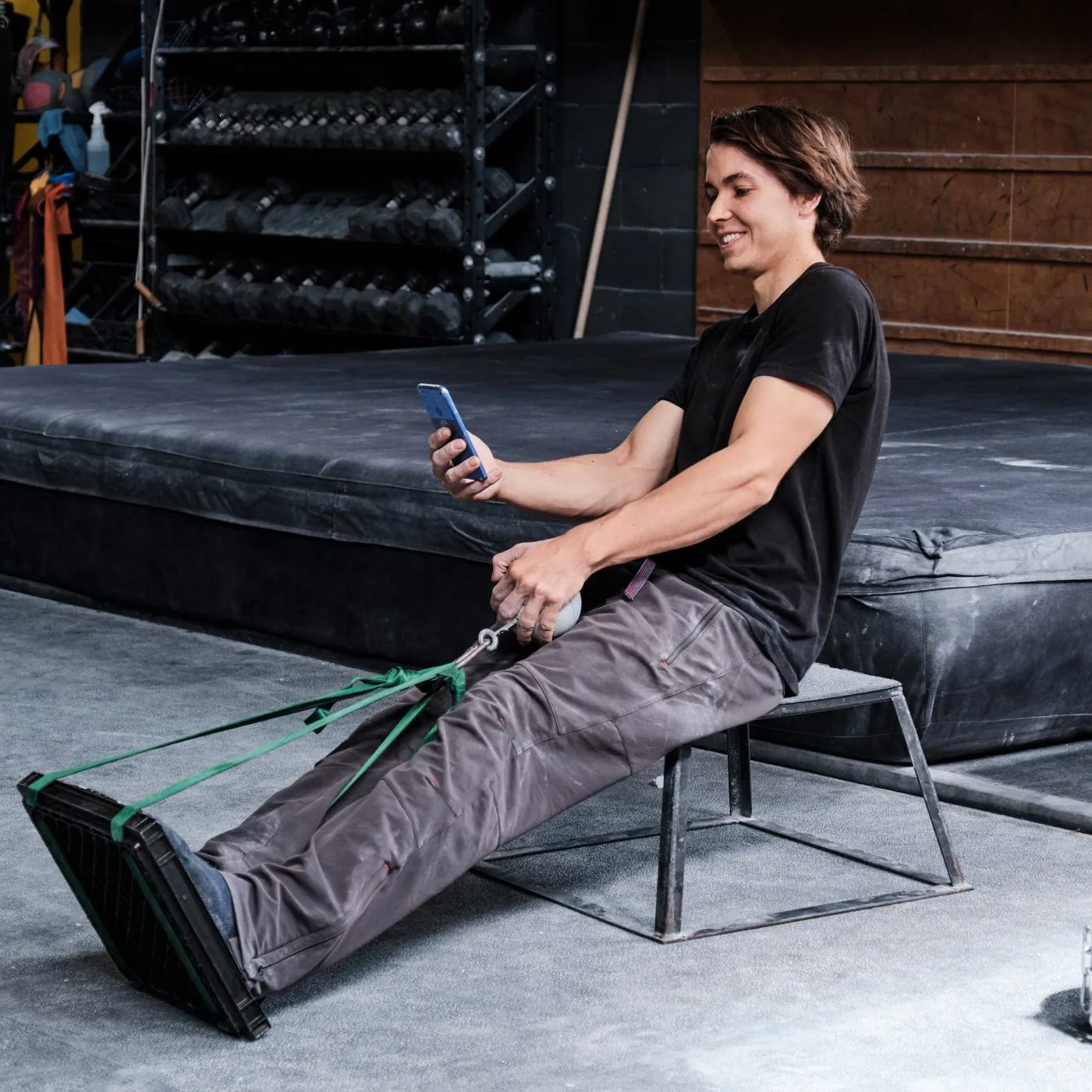
| Setup | 20 mm edge, half crimp, one or both hands depending on your setup | One hand on a 20 mm edge, half crimp | Feet supported, standing or sitting; take up the slack with a small, steady pull |
| Before | Warm-up, then two pulls at about 50% and 80% effort | Warm-up | Warm-up |
| The pull | As hard as you can for about 5 s | 7 s as hard as you can, 3 s rest, 24 times, all-out every time even as your force drops | As hard and as fast as you can, with no dip or jerk first |
| Attempts | Three, 3 min rest between; keep the best | One per hand | Several; keep the best |
| Result | Newtons or kilograms, and % of bodyweight | The average force of your last few pulls | How steeply force rises in the first fraction of a second |
| Without a sensor | The heaviest load you can hang for 7 s on the same edge, added in small steps with full rest, plus your bodyweight | Not possible | Not possible |
The weighted-hang version of the maximum test is the method of the 2024 Crimpd study.
Definitions of critical force differ. The Entralpi app averages the peaks of the last sixth of the pulls, which reads higher than research critical force. The critical force test gives the full protocol and how far to trust the number.
How do you read your results?
Compare yourself with yourself first. Against others, use a percentage of bodyweight: normalized to body mass, the 2025 study found no significant difference between male and female climbers in finger strength or endurance.
Use critical force to see whether your endurance improves; it reads high for setting training loads, so set endurance intensities below it.
RFD is noisier than peak force, so watch the trend over sessions rather than one result.
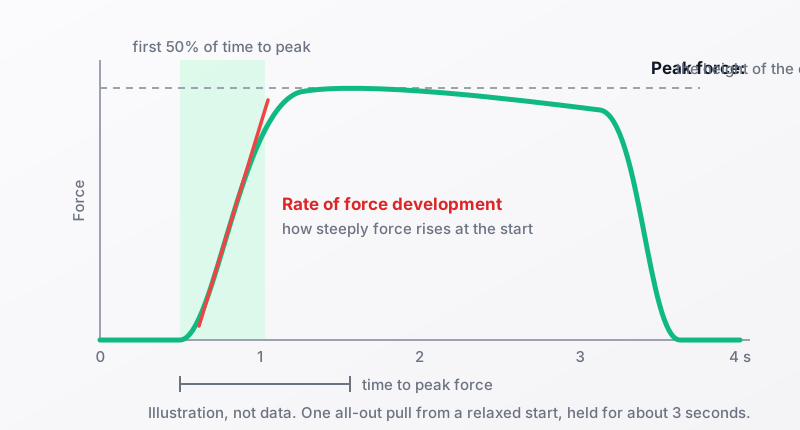
One pull: peak force is the height of the curve, rate of force development the steepness of the rise.
Rate of force development explains what the number means and how to train it.
Which tools can run which test?
| Tool | Max force | Critical force | Rate of force development |
|---|---|---|---|
| Weights and a timer | Yes (heaviest 7-second hang) | No | No |
| Crane scale | Peak only | Hard to run | No |
| Inline load cell (e.g. Tindeq) | Yes | Yes | Yes, within its sample rate |
| Ground force plate (e.g. Entralpi) | Yes | Yes | Yes, within its sample rate |
RFD needs a device that samples quickly and shows the force curve. Research setups typically record at 200 samples per second or more; the Entralpi plate records at up to 100, enough to follow your own trend over a 0 to 200 ms window but not to compare with lab values. Crane scale vs force plate compares the devices.
Do this in Entralpi
The app has three tests, each with its own page: The max strength test, The endurance test and The finger strength test. How to start one is on Take a test, and What each test measures explains each number, including the speed of a pull (RFD), which comes with the max strength test.
Sources
- Berta P, et al. (2025). Validity and normative scores of finger flexor strength and endurance tests. Journal of Sports Sciences, 43(3).
- Pérez-Cordero J, et al. (2025). Reliability of finger strength assessment methods in climbing: a systematic review. Frontiers in Sports and Active Living.
- Giles D, et al. (2019). The determination of finger-flexor critical force in rock climbers. International Journal of Sports Physiology and Performance.
- Baláš J, et al. (2024). Measuring critical force in sport climbers: a validation study of the 4 min all-out test on finger flexors. European Journal of Applied Physiology.
- Gilmore NK, et al. (2024). Effects of different loading programs on finger strength in rock climbers. Sports Medicine – Open.
Was this helpful?
Thank you. It tells us which articles to improve.
Sorry this did not answer your question. Write to us if you need an answer, or try the search above.
Thank you. It helps us improve this page.