Crane Scale vs Force Plate for Climbing
Updated 4 min read Testing Félix Bourassa-Moreau
On this page
A crane scale is enough if you only want a max pull number every month or two. For live feedback, the critical force test, rate of force development, or measuring on your own hangboard without rigging, you want an inline load cell or a force plate. All three are accurate enough for a max test every few weeks.
How does each tool work?
Crane scale. A hanging scale made for weighing loads, usually clipped between a sling on a hold and an anchor on the floor. You pull up on the hold and the scale reads the tension. Community apps such as the open-source Dyna connect to Bluetooth models like the WH-C06.
Inline load cell. The same principle, but built for climbing: a sensor rigged between a hold and an anchor that streams force to an app many times per second. The Tindeq Progressor, PitchSix Force Board and Frez Dyno work this way, as does Crimpdeq, an open-source sensor you build yourself.
Ground force plate. You stand on the plate and hang from any hangboard, block or bar. The plate measures how much of your weight leaves it; that difference is the force your fingers are holding. No rigging, and the hold can be anything. This is how Entralpi works.
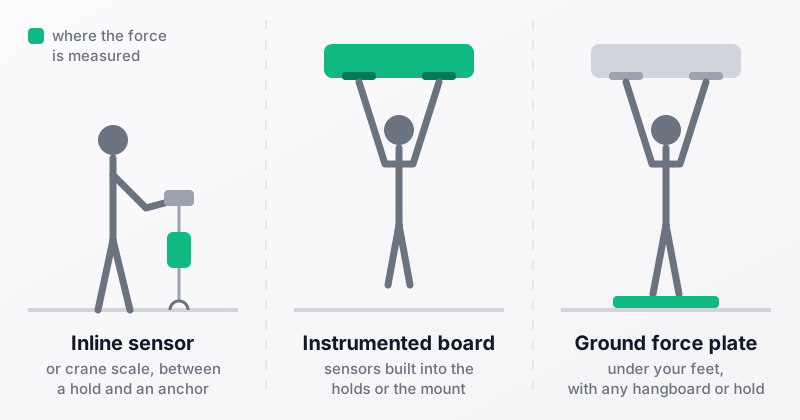
Where each type of device measures the force, shown in green.
What can each tool measure?
| Measurement | Crane scale | Inline load cell | Ground force plate |
|---|---|---|---|
| Peak force of a single pull | Yes | Yes | Yes |
| Live force during a hang | Depends on the app and scale | Yes | Yes |
| Critical force test (24 pulls) | Possible, awkward | Yes | Yes |
| Rate of force development | Not reliably | Yes, within its sample rate | Yes, within its sample rate (Entralpi: 100 Hz); body movement adds noise |
| Works on your hangboard as mounted | No, needs a rigged hold | No, needs a rigged hold | Yes |
| Dead hangs with full bodyweight | No | Needs a harness setup | Yes |
The key difference is not the sensor but the setup. Inline tools measure a pull on a rigged hold, which suits one-arm tests and travel. A force plate measures what happens on the board you already train on, including full-bodyweight hangs, and needs only floor space.
How accurate are they?
- Tindeq Progressor. Compared with a laboratory force plate in 25 climbers, it showed excellent agreement (ICC 0.99), with limits of agreement of 22 N in one-arm rung pulls and 37 N in lock-offs.
- Entralpi force plate. Compared with a laboratory force platform, it showed ICC 0.991 and a mean relative error of 0.41% in finger flexor tests.
- Crane scales. Sellers list a static accuracy, but we found no published study validating a crane scale for dynamic finger force testing, and most do not publish a sample rate. The Dyna app’s developer reports that the WH-C06 sends about 8 readings per second, too few to measure rate of force development. Static accuracy tells you how well it weighs a sack of flour, not how well it tracks a fast pull.
Any of these is accurate enough for a maximum force test repeated every few weeks. The differences show up in fast measurements, long tests and convenience:
- Sample rate. Research setups for rate of force development record at 200 samples per second or more. The Entralpi plate records at up to 100, enough to follow your own trend over a 0 to 200 ms window but not to compare with lab values.
- Body movement. A ground plate reads your hand force through the change in your weight on the plate, so a dip or a sway during a fast pull shows up as finger force. For static hangs and slow pulls the effect is negligible.
Which one should you choose?
A crane scale is enough if you mainly want a max pull number every month or two, you are happy to rig a hold and an anchor each time, and budget matters most. It is a fine way to find out whether numbers help your training.
A dedicated device is worth it when you want to:
- train with live feedback, holding a target percentage during max hangs, repeaters or no-hangs;
- run the critical force test or track rate of force development, which both need a steady stream of fast readings (how to test finger strength covers the tests).
Choose an inline load cell for portability and one-arm pulls. Choose a force plate to measure on the hangboard you already own, gym boards or any hold, with no rigging.
Every device compared
Prices, sample rates and app plans below come from each manufacturer’s site and are kept up to date in one place.
| Device | Price | Sample rate | Max load | Works with | App |
|---|---|---|---|---|---|
| Ground force plates | |||||
| Entralpi Force Plate | $185 | 100 Hz | 150 kg | Any hangboard or hold | Free |
| Inline load cells | |||||
| Tindeq Progressor 200 | US$160 | 80 Hz | 200 kg | Any hangboard or hold | Free |
| PitchSix Force Board Portable | US$169 | 80 Hz | 300 kg | Any hangboard or hold | Free, optional paid tier |
| Frez Dyno | US$89 | 250 Hz | 300 kg | Any hangboard or hold | Free, optional paid tier |
| DIY Crane scale (e.g. WH-C06) | from US$25 | – | – | Any hangboard or hold | Third-party apps |
| Instrumented hangboards | |||||
| Climbro Mini | from US$299 | 100 Hz | – | Its own holds | Free, optional paid tier |
| Climbro Pro | US$749 | 100 Hz | – | Its own holds | Free, optional paid tier |
| SmartBoard SmartBoard Pro | from €2,290 | – | – | Its own holds | Included, no subscription listed |
| Sensor mounts for a specific hangboard | |||||
| SmartBoard mySmartBoard | €662.50 | – | – | Beastmaker or YY board | Included, no subscription listed |
| Griptonite Motherboard | £349.99 | – | – | Beastmaker 1000/2000 | Free, optional paid tier |
| Timing boards (no force measurement) | |||||
| Zlagboard Pro / Evo | €99 | – | – | Its own holds | Included, no subscription listed |
Do this in Entralpi
The app’s tests need your plate and a hold to pull on (Take a test). What each test measures says how the app counts each number. Without the plate, the timer runs a session but measures no force.
Sources
- Labott BK, et al. (2022). Validity and reliability of a commercial force sensor for the measurement of upper body strength in sport climbing. Frontiers in Sports and Active Living.
- MacDougall KB, et al. (2023). Validity of the Entralpi force plate in the assessment of finger flexor performance metrics in rock climbers. Sports Biomechanics.
- Dyna, an open-source app for the WH-C06 crane scale.
- Crimpdeq, an open-source force sensor you build yourself.
Was this helpful?
Thank you. It tells us which articles to improve.
Sorry this did not answer your question. Write to us if you need an answer, or try the search above.
Thank you. It helps us improve this page.