Repeaters for Climbing Endurance
Repeaters are series of short hangs with short rests, classically 7 seconds on and 3 off, six times in a row. The load decides what they train: around 80% of max gave strength and endurance gains, around 60% trained endurance without much strength.
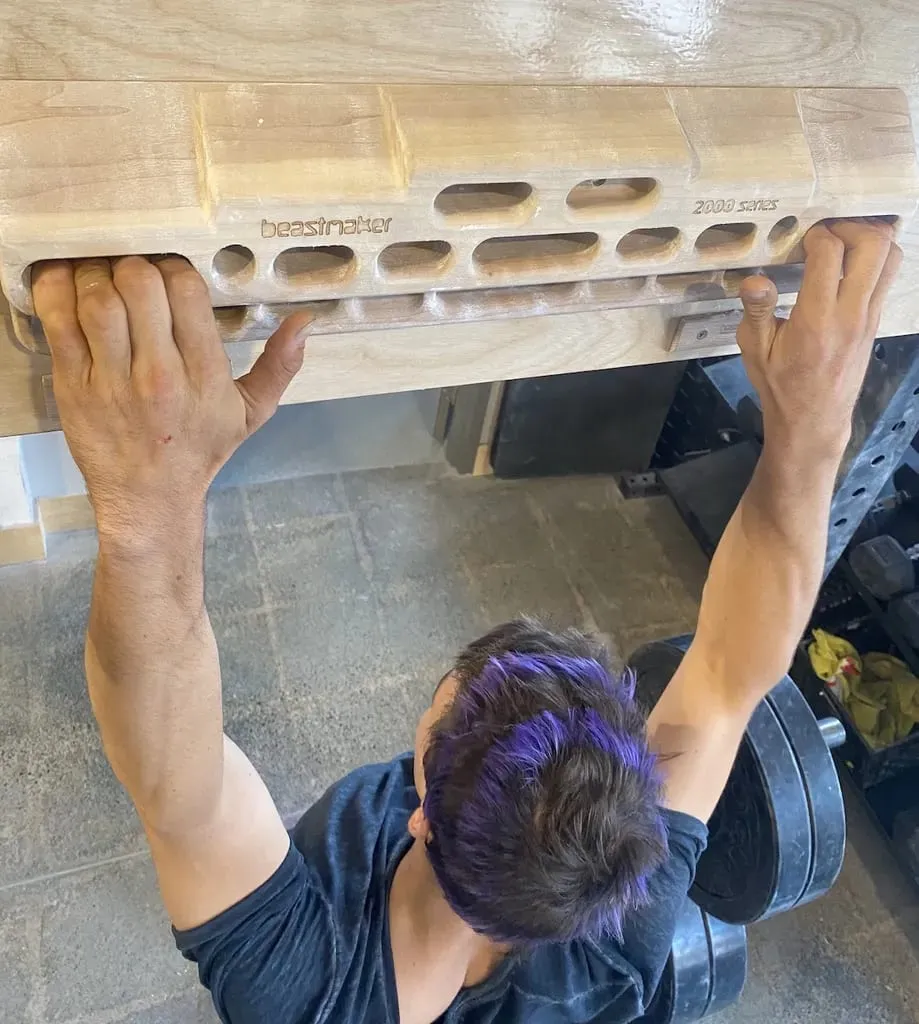
They mimic the grip-and-release rhythm of climbing a route, which is why they are a staple of hangboard training, popularized by the Anderson brothers’ Rock Climber’s Training Manual. Coach Eric Hörst also presents a 7/3 repeater protocol on his site.
This article explains what repeaters train, how intensity changes the result, and how to run a session.
What do repeaters train?
A single long hang drains the forearm quickly. Short rests let some blood flow back in between contractions, so you can keep producing force for longer. That capacity, holding hard grips repeatedly without fading, is what a pumpy route asks for.
Research backs the idea that intermittent endurance matters. In a 2025 study of 307 climbers, finger strength explained most of the variance in climbing ability, and an intermittent endurance test was the next strongest predictor.
Intensity decides the outcome
The same on-off rhythm can train different things depending on the load.
A 2022 trial split 54 climbers into groups training twice a week for 4 weeks:
| Group | Protocol | Max strength | Endurance |
|---|---|---|---|
| F100 | 6 s maximal one-hand pulls, 3 min rest | +14.3% | No significant change |
| F80 | 10 s at 80% of max, 6 s rest, up to 12 reps, 3 sets | +12.4% | Improved |
| F60 | 10 s at 60% of max, 6 s rest, 24 reps, 2 sets | +5.9% (not significant) | Improved |
The practical reading: heavy repeaters, around 80% of your maximum, gave nearly the strength gain of maximal hangs and improved endurance as well. Light repeaters, around 60%, train endurance without much strength. Eva López found a similar pattern over 8 weeks, with intermittent hangs raising grip endurance 45%, against 34% for maximal hangs.
Where does critical force fit?
Every climber has a critical force: the highest intensity you can sustain in an intermittent effort without eventually failing. It averages around 41% of maximum force in trained climbers. Above it, you are spending a limited reserve that runs out in minutes; below it, you can keep going for a long time.
That gives a simple rule for programming repeaters:
- Well above critical force (70 to 85% of max): short sets that run you out of reserve. Trains strength-endurance and the size of that reserve.
- Just around critical force (40 to 50% of max): long sets that feel steady. Trains the aerobic capacity of the forearm, which raises critical force itself.
Our finger strength testing guide explains how to estimate both your maximum and your critical force.
What does a repeater session look like?
Warm up with easy climbing and a few progressively harder hangs.
Choose one format for the block:
| Goal | Hang / rest | Reps per set | Sets | Rest between sets | Load |
|---|---|---|---|---|---|
| Strength-endurance | 7 s / 3 s | 6 | 4 to 6 | 3 min | About 75 to 80% of max |
| Aerobic base | 7 s / 3 s | 10 to 12 | 3 to 5 | 2 min | About 40 to 50% of max |
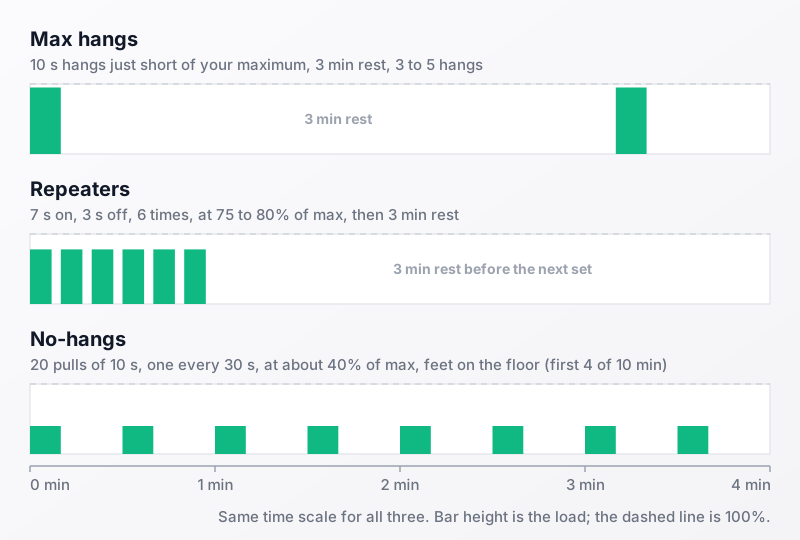
One strength-endurance set of repeaters, next to max hangs and no-hangs on the same time scale.
Set the load so the last rep of each set is hard but clean. If your grip opens or you drop before the last rep, reduce the load; if the whole set feels easy, increase it next session.
Train twice a week for 4 to 6 weeks, then retest.
Common mistakes
- Chasing the pump. Repeaters should end with your grip still intact. Grinding through failure trains your pain tolerance more than your fingers.
- Mixing loads within a set. Keep the edge and load the same for the whole set so the stimulus is consistent.
- Always using bodyweight. Bodyweight on a given edge might be 60% of max for one climber and 95% for another. Relative loads are what the research used.
Measuring load in real time
The studies above prescribed repeaters as percentages of maximum force. That is hard to do with a weight belt, because your effective load depends on how hard you pull. A force sensor shows it directly. On a ground force plate like Entralpi, you stand on the plate under your hangboard and the app shows how much of your weight your fingers are holding, rep by rep, so you can keep every hang in the target zone and see when fatigue sets in.
More on endurance and the pump: finger endurance training, density hangs and the critical force test.
Do this in Entralpi
In the app, the number at the top of a set is how many times the set is done, so one hang and one rest done six times is a repeater (Build your own workout). The max strength test measures your max (Take a test); type it in Settings (Profile, then Settings, under Physical profile) and a workout in % max uses it. The endurance test gives your critical force.
Sources
- Berta P, et al. (2025). Validity and normative scores of finger flexor strength and endurance tests. Journal of Sports Sciences, 43(3).
- Devise M, et al. (2022). Effects of different hangboard training intensities on finger grip strength, stamina, and endurance. Frontiers in Sports and Active Living.
- López-Rivera E, González-Badillo JJ (2019). Comparison of the effects of three hangboard strength and endurance training programs on grip endurance in sport climbers. Journal of Human Kinetics, 66.
- Giles D, et al. (2019). The determination of finger-flexor critical force in rock climbers. International Journal of Sports Physiology and Performance.
- Hörst E (2019). Hangboard finger training: the 7/3 repeater protocol. Training for Climbing.