Max Hangs: How to Do Them Right
Updated 6 min read Finger strength Félix Bourassa-Moreau
On this page
Hang 10 seconds at a load you could hold about 3 seconds longer, 3 to 5 times with 3 minutes of rest, twice a week for 4 to 8 weeks. It is the best-studied way to build maximal finger strength, though the trials are small and most differences between methods were not statistically significant.
How do you do a max hang?
| Parameter | Setting |
|---|---|
| Edge | 18 to 20 mm, half crimp |
| Hang length | 10 seconds |
| Effort | Hard enough that you could hold about 3 more seconds; never to failure |
| Rest between hangs | 3 minutes; shorter rests shift the work toward endurance |
| Hangs per session | 3 to 5 |
| Sessions per week | 2, with at least 48 hours between |
| Placement | At the start of a session, after the warm-up; keep the rest of the day moderate, no limit bouldering on top |
| Progression | When the last hang of a session feels easy, add 1 to 2 kg next session |
| Block length | 4 to 8 weeks, with the edge, grip and hang length fixed |
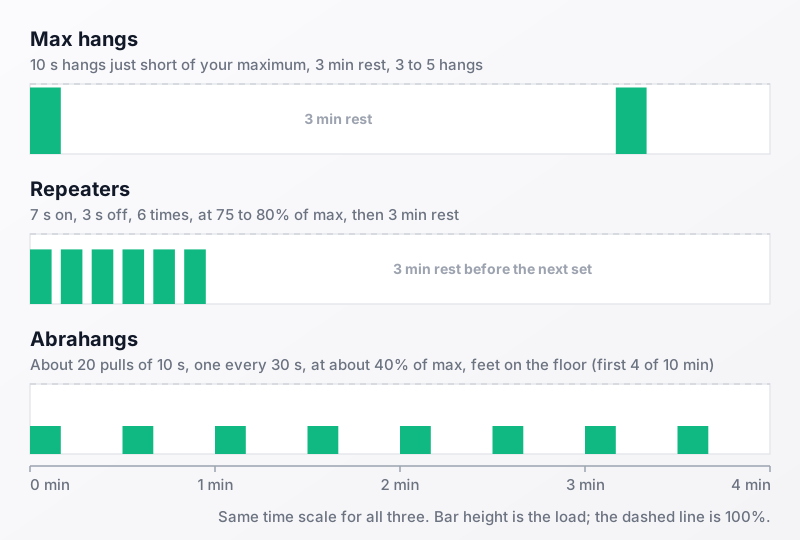
Max hangs are short and heavy, with long rests. Repeaters and Abrahangs are drawn on the same time scale for comparison.
Warm up first. Ten to fifteen minutes of easy climbing or progressively harder hangs; the warm-up routine sets out a ramp. Cold fingers are how pulleys get hurt.
Find your load. Test your maximum at the start of the block, or start at body weight on your edge. If you can hold it for 13 seconds or more, add weight with a belt; if you cannot hold 10, take weight off with a pulley. Most people underestimate the load in the first session and overestimate it in the second, so adjust after every hang. A weight belt tells you what you added, not how hard you pulled, so anything that shows your actual pull helps.
Keep the grip honest. Shoulders engaged, arms straight but not locked. If your grip opens or you start to shake at second 6, the load is too high.
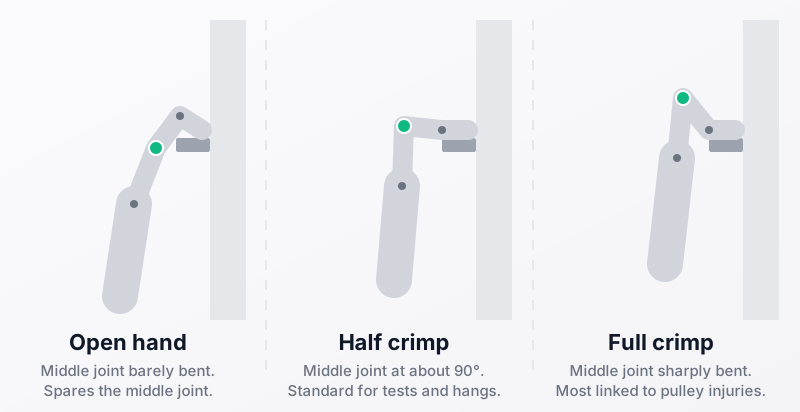
Max hangs use a half crimp, in the middle: the middle joint, marked in green, at about 90°.
To make a hang harder you can also use a smaller edge instead of more weight; smaller edges or more weight weighs the two.
How hard is a body-weight hang?
It depends on how strong each hand is. With both hands on the edge and no added weight, a hang uses body weight ÷ (2 × one-hand maximum). If one hand pulls 100% of your body mass, a body-weight hang is about 50% of your maximum; at 80%, it is about 63%; at 60%, about 83%. The same body-weight hang is easy training for one climber and near-maximal for another. That is why a 2025 study of 307 climbers stresses that body mass and strength change the intensity of a fixed test.
Why do max hangs make fingers stronger?
This is general sports science, measured in other muscles, not in climbers’ fingers.
- The first gains are mostly neural. After 4 weeks of strength training of a shin muscle, the same motor units were recruited earlier and fired faster (Del Vecchio 2019). The nervous system drives the muscle harder before the muscle grows, and short, near-maximal efforts train exactly that.
- Tendons adapt more slowly, and to intensity. In a meta-analysis of training studies of 8 weeks or more, the size of the load mattered more for tendon adaptation than the type of contraction (Bohm 2015).
- Tendons rebuild between sessions. After loading, tendon collagen synthesis peaks about 24 hours later and stays raised for about 72 hours (Miller 2005; Magnusson 2010). That is why the protocol leaves at least 48 hours between heavy sessions.
What does the research show on max hangs?
Much of it comes from sports scientist and climber Eva López, who compared hangboard methods in controlled studies.
- Max hangs may build strength fastest. In López’s 8-week comparison, presented at a 2016 congress and not published in a peer-reviewed journal, max hangs raised maximal finger strength about 28%, against about 14% for intermittent hangs. The difference was not statistically significant.
- They help endurance less than intermittent work. In the published version with 26 advanced climbers, grip endurance rose 34% with max hangs and 45% with intermittent hangs, again not a significant difference.
- Heavy work is specific. In a 2022 trial with 54 climbers, 4 weeks of 6-second maximal one-hand pulls raised maximal strength by 14.3% but not endurance. Hangs at 80% of maximum improved both, strength by 12.4%.
- Real-world gains are smaller but real. In 2024 app data from 526 climbers, max hangs raised strength-to-weight by 3.2% on average over 4 to 16 weeks, while climbing alone did not. The measures and populations differ from the lab studies, and real life has missed sessions and guessed loads.
Who should do max hangs?
Max hangs load the finger tendons and pulleys heavily. They suit climbers who:
- have been climbing regularly for a couple of years and can already hang a 20 mm edge comfortably,
- have no current finger pain or recent pulley injury,
- can commit to two sessions a week for at least four weeks.
If you are newer to climbing, climbing itself will build finger strength for a long time. No-hangs or repeaters at modest loads are a gentler start.
Do this in Entralpi
The max strength test measures your max (Take a test). Keep it with one tap at the end of the test, or type it in Settings (Profile, then Settings, under Physical Profile, Max strength) and you can set each hang as a percentage of it. Choose a workout from the Train tab or build your own with loads in % max. Without the plate, the timer runs the session but measures no force.
Sources
- López-Rivera E, González-Badillo JJ (2019). Comparison of the effects of three hangboard strength and endurance training programs on grip endurance in sport climbers. Journal of Human Kinetics, 66.
- López-Rivera E (2018). Maximal hangs, intermittent hangs or a combination (summary of the 2016 IRCRA congress study).
- Devise M, et al. (2022). Effects of different hangboard training intensities on finger grip strength, stamina, and endurance. Frontiers in Sports and Active Living.
- Gilmore NK, et al. (2024). Effects of different loading programs on finger strength in rock climbers. Sports Medicine – Open.
- Del Vecchio A, et al. (2019). The increase in muscle force after 4 weeks of strength training is mediated by adaptations in motor unit recruitment and rate coding. Journal of Physiology, 597(7).
- Bohm S, Mersmann F, Arampatzis A (2015). Human tendon adaptation in response to mechanical loading: a systematic review and meta-analysis of exercise intervention studies on healthy adults. Sports Medicine – Open, 1.
- Miller BF, et al. (2005). Coordinated collagen and muscle protein synthesis in human patella tendon and quadriceps muscle after exercise. Journal of Physiology, 567(3).
- Magnusson SP, Langberg H, Kjaer M (2010). The pathogenesis of tendinopathy: balancing the response to loading. Nature Reviews Rheumatology, 6(5).
- Berta P, Michailov M, Kaško D, Gajdošík J, Běhounek M, Baláš J (2025). Validity and normative scores of finger flexor strength and endurance tests estimated from a large sample of female and male climbers. Journal of Sports Sciences, 43(3).
Was this helpful?
Thank you. It tells us which articles to improve.
Sorry this did not answer your question. Write to us if you need an answer, or try the search above.
Thank you. It helps us improve this page.