Critical Force Test for Climbers
Updated 5 min read Testing Félix Bourassa-Moreau
On this page
Critical force is the highest intermittent force you can sustain for a long time: about 41% of your maximum in trained climbers, held for minutes rather than indefinitely. You find it with a 4-minute all-out test. The result tracks change reliably but reads high, so set endurance loads below it.
What is critical force?
Sports scientists borrowed the idea from critical power in cycling. In climbers, Giles, Fryer and colleagues defined it in 2019 from repeated finger contractions at different intensities. It averaged about 41% of maximum voluntary force in trained climbers, and a single-session test agreed well with the longer multi-session method (ICC 0.90).
The model gives two numbers:
- Critical force (CF): the sustainable intensity. Below it, you can keep repeating hard grips for much longer.
- W′ (W prime): the reserve you can spend above critical force before you fail, like a battery. It runs out in minutes.
A pumpy route is a story of both: how close to your critical force the climbing sits, and how quickly the hard sections drain your reserve.
How do you run the 4-minute all-out test?
This is the version most climbers and apps use, as described in a 2023 reliability study:
| 4-minute all-out test | |
|---|---|
| Warm-up | 10 to 15 minutes, including a few submaximal pulls |
| Setup | One hand on a 20 mm edge, half crimp, with a force sensor measuring the pull |
| The pulls | 7 s as hard as you can, 3 s rest, 24 times. No pacing: every pull is all-out, even as your force falls |
| Peak force | Your highest single pull |
| Critical force (end-test force) | The average of your last few pulls |
| Reserve | The area under the force curve above critical force (impulse above end-test force) |
| Other hand | Rest, then repeat if you want both sides |
| Device | One that records every pull, not just the peak: an inline load cell or a force plate |
Studies define the last pulls differently: a 2024 validation study compared the mean force of the last three pulls with their end-force, and the Entralpi app averages the peaks of the last sixth, 4 of 24.
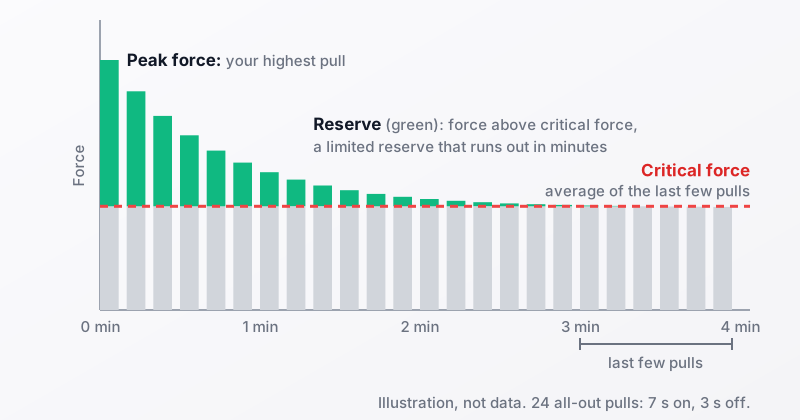
Peak force, critical force and the reserve above it, in a 24-pull all-out test.
The last minute is where the number is made, so commit to every pull. On a ground force plate like Entralpi, you stand on the plate and pull on your hangboard’s 20 mm edge; the 2023 reliability study ran this test on an Entralpi plate. A crane scale sends only a few readings per second, so the result is rougher. Crane scale vs force plate compares the devices.
How far can you trust the result?
For tracking change, it is good. The 2023 study found peak force very reliable (ICC 0.94, 5.6% variation) and end-test force good (ICC 0.85), although end-test force varied by about 21% between days. A 2026 study found repeat all-out tests extremely consistent (ICC 0.97).
The number is not truly sustainable. The 2024 validation study of 12 climbers took critical force as the mean force of the last three pulls (20.1 kg on average), then had them work at that force. They failed after 440 seconds on average, about 7 minutes, and only 1 of 12 lasted the full 12 minutes. The end-force of the same pulls (16.8 kg) predicted sustainable work better. The Entralpi app’s critical force averages the peaks of the last pulls, so it sits on the high side of these definitions and reads higher than research critical force.
For setting loads, it runs high. The 2026 study compared the all-out test with the classic method of several constant-force tests to exhaustion: 122 N on average against 98 N. The authors concluded it is likely unsuitable for prescribing exercise intensity.
So use the all-out result to see whether your endurance improves from one block to the next. To set training loads from it, aim about 20% below it (a margin derived from the 2026 study’s averages, 98/122, not a tested rule), or start from the classic ratio of about 40% of your maximum, then adjust by feel and by how sets go.
Is there a gentler test?
Yes, a submaximal one: 7 seconds on, 2 seconds off at 60% of your maximum, until you can no longer hold the target. In a 2022 study of 52 climbers, this test combined with maximal strength explained 46% of the variance in lead climbing ability in men and 32% in women. The authors recommend a small tolerance before stopping (about 5% below target for men, 7% for women), so a single wobble does not end the test.
How do you use critical force in training?
Train on both sides of it. Long, easy work below critical force, the aerobic base (30 to 40% of max), raises critical force itself; short, hard intervals above it train the reserve. Finger endurance training sets out the zones and sessions, and repeaters the classic interval protocol.
Do this in Entralpi
The app’s endurance test is a 4-minute all-out test with one hand. It gives your critical force and your sustainable force (The endurance test). Endurance, recovery and rehab workouts set their targets from the sustainable force, and What each test measures explains each number.
Sources
- Giles D, et al. (2019). The determination of finger-flexor critical force in rock climbers. International Journal of Sports Physiology and Performance.
- McClean ZJ, et al. (2023). Test-retest reliability of a 4-minute all-out critical force test in rock climbers. International Journal of Exercise Science.
- Baláš J, et al. (2024). Measuring critical force in sport climbers: a validation study of the 4 min all-out test on finger flexors. European Journal of Applied Physiology.
- Boklaschuk P, MacDougall K, MacInnis M (2026). The validity and utility of the all-out test for forearm flexor critical force. European Journal of Applied Physiology.
- Augste C, Winkler M, Künzell S (2022). Optimization of an intermittent finger endurance test for climbers regarding gender and deviation in force and pulling time. Frontiers in Sports and Active Living.
Was this helpful?
Thank you. It tells us which articles to improve.
Sorry this did not answer your question. Write to us if you need an answer, or try the search above.
Thank you. It helps us improve this page.