Rate of Force Development for Climbers
Updated 4 min read Finger strength Félix Bourassa-Moreau
On this page
Rate of force development (RFD) is how quickly you reach high force, and you train it with short, maximal pulls made as fast as possible, with full rest, on fresh fingers. In 4 weeks of such training, elite climbers improved early RFD by 27.5 to 32%. The evidence comes from a handful of small studies, several of them on whole-body pulls rather than fingers alone.
What is rate of force development?
RFD is the slope of the force curve at the start of a pull. Your maximum force is the height of the curve; RFD is how steeply it rises. On a deadpoint, a catch or a quick crimp, you often have only a fraction of a second to load the hold, so two climbers with the same maximum can differ: the one who reaches full strength a moment too late misses the hold.
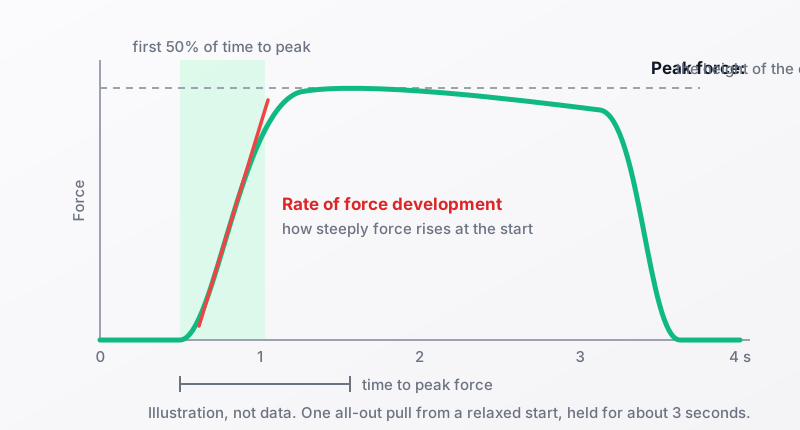
Peak force is the height of the curve. RFD is the slope of its rising part, often analysed over the first 50% of the time to peak.
Does RFD separate better climbers?
In an isometric pull-up on a 23 mm rung, which uses the fingers, arms and back together, yes. In 57 male lead climbers, elite climbers had much higher peak force and RFD than intermediate and advanced climbers, who did not differ from each other. In a larger sample, elite climbers produced 74.9% higher RFD than advanced climbers, against 39.7% higher peak force.
Part of the difference is in the nervous system. In a 2023 study, a sudden loud sound sped up force development in both climbers and untrained people, but climbers’ advantage in early force appeared only after the startle, which the authors tentatively link to training adaptations in the pathways that drive fast contractions.
How do you train RFD?
Four weeks of hangs on small holds, twice a week, improved early RFD in elite French competition climbers by 27.5 to 32%, with an 8% gain in maximum force on a sloping crimp. Such quick gains point to the nervous system, not bigger muscles. Strength work alone may not do it: five weeks of weighted one-arm finger pulls improved dynamic finger strength in boulderers but did not change RFD.
- Intent is the stimulus. Every rep is a maximal, as-fast-as-possible pull, not a slow squeeze.
- Short efforts, full rest. A few seconds of pulling with 2 to 3 minutes of rest keeps the quality high.
- Small or specific holds, on the grips you need on the wall.
- Low volume, twice a week.
- Fresh fingers only. Put RFD work at the start of a session, after the warm-up, never after hard climbing.
Explosive loading is demanding on pulleys. If you are new to hangboarding or returning from a finger injury, build a base with max hangs or no-hangs first.
How do you measure RFD?
- Warm up thoroughly.
- Stand or sit with your feet supported and your hand on a 20 mm edge, half crimp. The test starts with your weight on your feet, not from a hang, because you cannot be relaxed while hanging.
- Take up the slack with a small, light pull, and hold it steady.
- On your own count, pull as hard and as fast as you can for about 3 seconds. Think “fast” first.
- Rest 2 to 3 minutes. Do three to five attempts and keep the best.
- Start the same way every time: no dip, jerk or slack-then-yank. A countermovement inflates the number; a large pre-load hides part of the rise.
RFD is noisier than peak force, so judge the trend over several sessions rather than a single number. You need a device that samples quickly and shows the force curve; research setups record at 200 samples per second or more. Crane scale vs force plate compares devices, and how to test finger strength places RFD beside maximum force and critical force.
Do this in Entralpi
The plate records at up to 100 samples per second, 20 points across a 200 ms window: enough to follow your own 0 to 200 ms RFD from one session to the next, too coarse for very early windows such as 0 to 50 ms, and not comparable with lab values. It reads your hand force through the change in your weight on the plate, so a dip, a sway or a lean shows up as finger force: stand still and pull straight. The app counts RFD over the first 200 milliseconds of the pull, in your unit per second (What each test measures). The tests are on Take a test. Without the plate, the timer runs a session but measures no force.
Sources
- Stien N, et al. (2021). Upper body rate of force development and maximal strength discriminates performance levels in sport climbing. PLOS ONE.
- Vereide V, et al. (2022). Differences in upper-body peak force and rate of force development in male intermediate, advanced, and elite sport climbers. Frontiers in Sports and Active Living.
- Levernier G, Laffaye G (2019). Four weeks of finger grip training increases the rate of force development and the maximal force in elite and top world-ranking climbers. Journal of Strength and Conditioning Research.
- Colomer-Poveda D, et al. (2023). Differences in the effects of a startle stimulus on rate of force development between resistance-trained rock climbers and untrained individuals. Scandinavian Journal of Medicine & Science in Sports.
- Saeterbakken AH, et al. (2024). Five weeks of dynamic finger flexor strength training on bouldering performance and climbing-specific strength tests. Frontiers in Physiology.
Was this helpful?
Thank you. It tells us which articles to improve.
Sorry this did not answer your question. Write to us if you need an answer, or try the search above.
Thank you. It helps us improve this page.