Abrahangs: Do Daily Low-Load Hangs Work?
Published 5 min read No-hangs Félix Bourassa-Moreau
On this page
Daily low-intensity hangs, popularised as Abrahangs, are about ten minutes of light pulls at roughly 40% of your maximum, feet on the floor, on most days. Evidence level: low to moderate. One 2024 analysis of app-logged training found a small gain, not significantly larger than with climbing alone; nobody was randomised and the loads were never measured.
What are Abrahangs?
Abrahangs are one protocol of the no-hang method: you pull on an edge with your feet on the floor, only until you feel a light strain in your forearms, which the 2024 study put at “~40% of max”. Climber Emil Abrahamsson created them and reported gains from short daily sessions. Gripped describes his original routine differently from the study: 10 seconds on and 50 seconds off, about 1 minute 40 seconds of hanging per session, twice a day, at a higher intensity. The 10-minute, 40% version below is the one the study logged.
How do you do Abrahangs?
| Parameter | As reported in the 2024 study (unless noted) |
|---|---|
| Edge | 18 to 22 mm, feet on the floor |
| Grips | Six hang variations, most of them two- and three-finger grips |
| Effort | Light forearm strain, about 40% of max |
| Rep | 10 seconds on, 20 seconds off: about 20 pulls |
| Session | About 10 minutes |
| Spacing | At least 6 hours from other workouts or climbing |
| Frequency | 3 or more sessions a week in the study; twice a day in Abrahamsson’s original routine |
| Duration | The study windows lasted 4 to 16 weeks |
| Progress | Retest your maximum every 4 to 8 weeks (coach practice) |
| Stop rules | Any finger pain, or a pull that stops feeling light (coach practice, not from the study) |
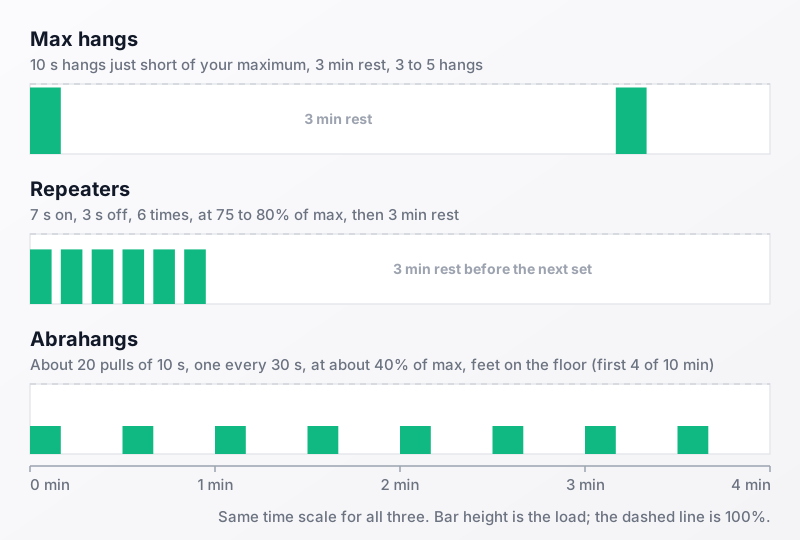
The first four minutes of an Abrahangs session: a light 10-second pull every 30 seconds at about 40% of max, against the few near-maximal hangs of max hangs and the dense sets of repeaters at 75 to 80%.
Keep it easy enough that you could do another session within hours, and pick grips you use on the wall. Add heavier work only on days your fingers feel fresh; How often to hangboard explains how to count total finger load, and density hangs are a related low-load format.
Do daily low-intensity hangs work?
They might, but the evidence is thin. The 2024 paper in Sports Medicine - Open (Gilmore, Klimek, Abrahamsson and Baar) looked back at 526 climbers who logged their training in the Crimpd app and tested their finger strength twice, 4 to 16 weeks apart: a 7-second half-crimp test on a 20 mm edge, relative to body weight. Ten outliers were left out, so the groups add up to 516.
| Group | Climbers | Change in strength-to-weight (mean) |
|---|---|---|
| Climbing only | 126 | No change |
| Abrahangs only (3 or more sessions a week) | 66 | +2.5% |
| Max hangs only (85 to 95% of the test load) | 200 | +3.2% |
| Both | 124 | +5.8% |
The authors concluded that low-intensity holds were about as effective as max hangs and that combining the two was additive. Read it with these limits, most of them stated by the authors:
- It was retrospective, not a randomised trial. Climbers picked their own programs and reported their own data, so motivation and selection can explain part of the result.
- The Abrahangs-only gain was small. It rose significantly from before to after (p < 0.01), but the authors call it a “positive trend” against climbing only (p = 0.12, not significant). It did not differ statistically from the max-hang gain, which is not the same as showing they are equal, and the group was the smallest.
- Force was not measured. How much weight climbers took off their feet was “self-regulated, unsupervised, and not measured”, so the 40% is an intention, not a verified load.
- Conflicts of interest. Abrahamsson created the protocol, Klimek designed the app, and Baar, whose ligament research the protocol rests on, is a co-author. That does not make the result wrong, but it is worth knowing.
- Few women (21 of 526), so the results say little about them.
The fair reading: Abrahangs look like a low-risk way to add finger training, especially alongside other work, and they deserve a proper randomised trial.
Why would light hangs help tendons?
The rhythm comes from Keith Baar’s work on lab-grown human ligaments. The cells’ response to stretch peaked after about 10 minutes and then switched off, and they needed about 6 hours before responding again. Ligaments loaded in 10-minute bouts every 6 hours made more collagen over 5 days than ligaments stretched continuously. For climbers, short sessions spaced through the day may give the connective tissue in your fingers more useful signals than one long session.
This is in vitro evidence. The engineered tissue behaves like developing tissue and is much weaker than an adult tendon, and Baar’s training recommendations are extrapolated from it, not tested in people. Treat it as a reasonable hypothesis, not a proven mechanism.
Who are Abrahangs for?
They suit climbers who want frequent, light finger loading in ten minutes with little equipment. Do not do them, or not without advice, if:
- you have current finger, pulley or tendon pain: ask a physiotherapist first, and use the loads they set;
- you are a growing teenager: check first with a coach or physiotherapist who knows adolescent climbers;
- you treat “light” as “free”: daily pulls still add to your total finger load.
Pain stops a session. Pain that lingers into the next day means you should rest and see a physiotherapist.
Do this in Entralpi
The max strength test measures your max; keep it with one tap at the end of the test, or type it in Settings (Profile, then Settings, under Physical Profile, Max strength), and a load in % max becomes kilograms. In the Train tab, pick a workout or build your own with 10-second pulls, 20 seconds of rest and a load near 40% of your max. With your feet on the plate, the app shows the load live, the measurement the study lacked. Without the plate, the timer still paces the pulls and rests.
Sources
- Gilmore NK, Klimek P, Abrahamsson E, Baar K (2024). Effects of different loading programs on finger strength in rock climbers. Sports Medicine - Open, 10.
- Baar K (2017). Minimizing injury and maximizing return to play: lessons from engineered ligaments. Sports Medicine, 47.
- Gripped Magazine. A staggeringly successful new hangboard routine.
Was this helpful?
Thank you. It tells us which articles to improve.
Sorry this did not answer your question. Write to us if you need an answer, or try the search above.
Thank you. It helps us improve this page.