Draft: this guide is not published yet. It is hidden from search engines and not linked from the site.
Smart Hangboards: What They Are and How to Choose (2026)
By Félix Bourassa-Moreau, founder of Entralpi, building instrumented hangboards since 2013 · Last updated
What is a smart hangboard?
A smart hangboard is a hangboard setup that measures the force your fingers apply and sends it to an app. Instead of judging a session by whether you held on for ten seconds with a weight belt, you see the actual force, in kilograms or newtons, as you pull. That turns finger training from guesswork into something you can dose, test and track.
The term is mostly used for boards with sensors built in: Climbro’s website gives its tagline as “The First Smart Hangboard for Climbers”, Griptonite sells its Motherboard as a “smart hangboard with real-time force measurement”, and SmartBoard built its brand name on the idea. But the smart part is the sensor, not the wood. Entralpi’s Kickstarter campaign in 2019 was called “Make your hangboard smart” for that reason: a sensor under or behind any board makes that board smart.
The three types of smart hangboard
Ground force plates. You stand on a plate on the floor and hang from any hangboard, block or bar. The plate measures how much of your weight leaves it, which is exactly the force your fingers are holding. Entralpi works this way. It needs no installation or rigging, works on any hold, and measures full-bodyweight hangs as well as pulls with your feet on the floor.
Inline load cells. A sensor is rigged between a hold and an anchor, and you pull on the hold. The Tindeq Progressor, PitchSix Force Board and Frez Dyno are the best known; some climbers use a Bluetooth crane scale the same way. Inline sensors are small and very portable, and ideal for one-arm pulls, but every setup needs a rigged hold and an anchor point.
Instrumented boards and mounts. Sensors are built into a wall-mounted board (Climbro, SmartBoard Pro), or into a platform mounted behind a specific commercial board (Griptonite Motherboard behind a Beastmaker, mySmartBoard under a Beastmaker or YY board). They measure on those holds, stay on the wall, and suit a dedicated home or gym setup.
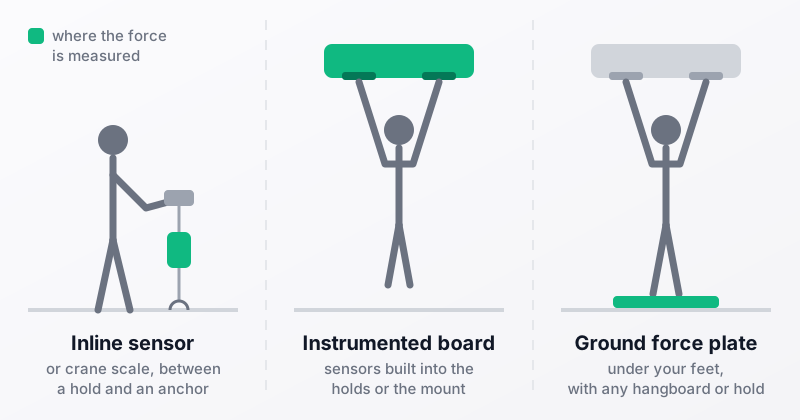
The three types of smart hangboard. Green marks where the force is measured.
A fourth kind of product is sometimes grouped with smart hangboards but does not measure force: boards that detect when you are hanging, to time your sessions. Zlagboard works this way. They are useful timers, not force sensors.
What a smart hangboard measures, and why it matters
Maximum force. The most force your fingers can produce. It is the main predictor of climbing ability: in a 2025 study of 307 climbers, finger strength was the dominant factor, accounting for about 68% (men) and 64% (women) of the variance in climbing ability that the tests explained, with intermittent endurance making up most of the rest (28% and 34%). Of the single tests, a finger hang correlated most strongly with grade (R ≈ 0.75).
Critical force. The highest intensity you can sustain in repeated hangs for a long time without fatigue building up steadily; a measure of forearm endurance. It averaged about 41% of maximum force in the climbers of the study that first measured it for the fingers, and it tells you how to set loads for endurance work.
Rate of force development. How fast you reach high force. In an isometric pull test, elite male climbers developed force about 75% faster than advanced climbers, a larger gap than in peak force.
Rehab loading. After a pulley injury, climbers can lose up to about half the strength of the injured finger in a one-finger crimp compared with the other hand: 54% on average in climbers with pain and a tear visible on ultrasound, much less in milder cases. Measuring both hands turns a return to climbing into a series of numbers you and your physiotherapist can follow, rather than a guess.
Reliability. None of this helps unless the numbers repeat. A 2025 systematic review found maximal finger strength tests highly reliable when the edge and grip are standardized. Two devices in the table below have peer-reviewed validation against laboratory force platforms: the Tindeq Progressor and the Entralpi force plate.
Our finger strength testing guide explains how to run each test.
Every smart hangboard compared
Here is every device we know of in the category, grouped by type. Prices, sample rates and app plans come from each manufacturer’s own site and are rechecked regularly; select a device to open its source.
| Device | Price | Sample rate | Max load | Works with | App |
|---|---|---|---|---|---|
| Ground force plates | |||||
| Entralpi Force Plate | $185 | 100 Hz | 150 kg | Any hangboard or hold | Free |
| Inline load cells | |||||
| Tindeq Progressor 200 | US$160 | 80 Hz | 200 kg | Any hangboard or hold | Free |
| PitchSix Force Board Portable | US$169 | 80 Hz | 300 kg | Any hangboard or hold | Free, optional paid tier |
| Frez Dyno | US$89 | 250 Hz | 300 kg | Any hangboard or hold | Free, optional paid tier |
| DIY Crane scale (e.g. WH-C06) | from US$25 | – | – | Any hangboard or hold | Third-party apps |
| Instrumented hangboards | |||||
| Climbro Mini | from US$299 | 100 Hz | – | Its own holds | Free, optional paid tier |
| Climbro Pro | US$749 | 100 Hz | – | Its own holds | Free, optional paid tier |
| SmartBoard SmartBoard Pro | from €2,290 | – | – | Its own holds | Included, no subscription listed |
| Sensor mounts for a specific hangboard | |||||
| SmartBoard mySmartBoard | €662.50 | – | – | Beastmaker or YY board | Included, no subscription listed |
| Griptonite Motherboard | £349.99 | – | – | Beastmaker 1000/2000 | Free, optional paid tier |
| Timing boards (no force measurement) | |||||
| Zlagboard Pro / Evo | €99 | – | – | Its own holds | Included, no subscription listed |
What the table does not show:
- Validation. Only the Tindeq Progressor and the Entralpi force plate have published peer-reviewed validation studies. That does not mean the others are inaccurate, only that no independent study has validated them against a reference device.
- Subscriptions. Several apps are free with an optional paid tier; check what the free plan includes before you buy.
- Where you can measure. Plates and inline sensors work on any hold; boards and mounts work on their own holds or on the specific board they are built for.
How to choose
If you already own a hangboard
A ground force plate makes your existing board smart without changing it: put the plate under it and train as usual. If you own a Beastmaker or YY board and want sensors behind that specific board, a mount such as the Griptonite Motherboard or mySmartBoard is the other option.
If you travel or train at the gym
Portability matters more than anything. Inline load cells are the smallest and fit in a chalk bag, but need an anchor at each location. A force plate fits in a backpack and works under any gym hangboard or campus rung with nothing to rig. Wall-mounted boards stay home.
If you coach, run a gym or share with a team
Look at how many profiles the app supports and whether athletes can use their own phones. Entralpi’s app allows unlimited profiles; mySmartBoard is limited to four user accounts. Setup time between athletes also matters: stepping on a plate is faster than re-rigging a sensor for each climber.
If you run research or rehab
Choose a device with published validation, data export and a sample rate that suits your measurements. Researchers can request devices for a study through our research program.
If budget comes first
A Bluetooth crane scale and an open-source app will give you a peak force number for a fraction of the price of any dedicated device. You give up live feedback, reliable fast measurements and convenience. Our crane scale, load cell and force plate comparison goes through the trade-offs honestly.
Do you need a smart hangboard at all?
Plenty of climbers have become very strong with a normal hangboard, a weight belt and a timer. You do not need a sensor to get stronger.
What measurement adds:
- An objective baseline. You know your starting point, and you know within a few weeks whether a program works.
- Precise loads. Protocols in the research, such as max hangs and repeaters, are prescribed as percentages of your maximum. With a sensor you can train at those percentages instead of approximating them. Light daily work like no-hangs especially benefits, because 40% of your maximum is almost impossible to feel accurately.
- Left and right hands. Imbalances show up immediately.
- Safer returns from injury. Load can be increased in small, measured steps.
Who can skip it: climbers in their first year or two, who will get stronger from climbing alone, and anyone who does not plan to train fingers outside climbing.
Questions climbers ask
Is a smart hangboard worth it?
It is worth it if you already hangboard regularly and want to know whether your training works. Measurement lets you test your strength, train at exact percentages of your maximum and track progress in numbers. If you climb a few times a week and do not hangboard yet, climbing itself will build finger strength for a long time, and a regular hangboard is enough to start.
Do beginners need a smart hangboard?
No. Beginners get stronger fingers from climbing alone for their first year or two. A smart hangboard becomes useful once you add structured finger training, return from a finger injury, or want an objective baseline to track.
What if I already own a hangboard?
Then you do not need a new board to make it smart. A ground force plate such as Entralpi sits on the floor under the board you already own and measures the force you apply to any hold on it. Inline load cells also work with your holds, but need a rigged hold and an anchor for each setup.
Is a smart hangboard better than a normal hangboard?
The holds are the same; what changes is the information. A normal hangboard tells you whether you held on. A smart setup tells you how hard you pulled, how fast you reached that force, and how it compares with last month, which makes loads safer to dose and progress easier to see.
Should I get a Tindeq or a smart hangboard?
A Tindeq Progressor is an inline load cell: very portable, validated, and great for one-arm pulls on a rigged hold. Board-based systems measure on their own wall-mounted holds. A force plate measures on any board or hold without rigging. Choose based on where you train and whether you want to measure full-bodyweight hangs on your existing board.