No-Hangs (Abrahangs) Explained
A no-hang is a hangboard exercise where your feet stay on the floor and you pull on an edge to only a set fraction of your strength, such as 40% of your max. It is often called an Abrahang.
You grip the edge and pull down as if trying to lift off. The protocol became popular as “Abrahangs” after climber Emil Abrahamsson reported large strength gains from short daily sessions, and it is now one of the most talked-about ways to train fingers.
This article explains the idea, the evidence, and how to do no-hangs without guessing your load.
How do you do a no-hang?
As described in the 2024 study below, an Abrahangs session is about 10 minutes long:
- feet on the ground, pulling at roughly 40% of maximum effort,
- twenty 10-second pulls spread over six grip positions, most of them two- and three-finger grips,
- 20 seconds of rest between pulls,
- at least 6 hours away from other workouts or climbing sessions.
Abrahamsson’s original routine was done twice a day.
The load is deliberately low. The point is frequent, gentle loading of the tendons and connective tissue rather than a hard strength stimulus.
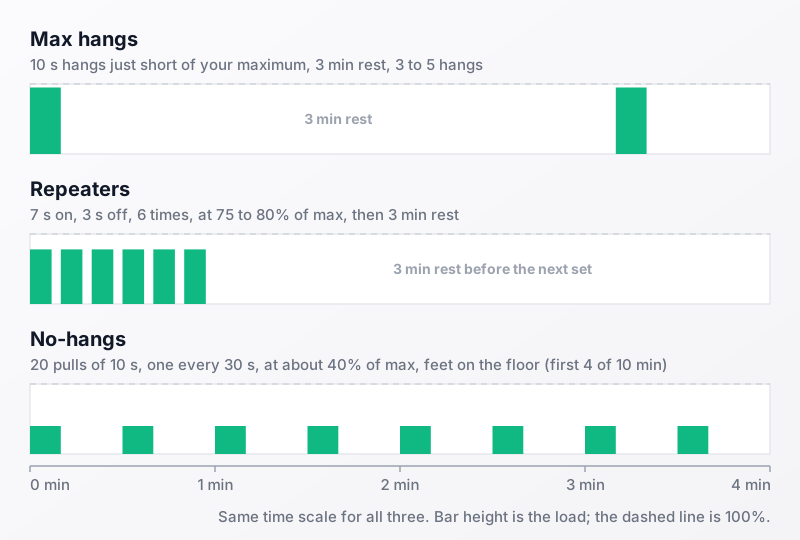
The first minutes of a no-hang session: light pulls at about 40% of maximum, next to max hangs and repeaters on the same time scale.
What is the science behind no-hangs?
The rhythm comes from tendon research by physiologist Keith Baar. In lab-grown ligaments, tissue became unresponsive to loading after a short time and needed hours to reset: 10-minute bouts repeated every 6 hours produced more collagen than continuous loading over the same days.
The logic for climbers follows: short sessions spaced through the day may give the connective tissue in your fingers more useful signals than one long session. Keep in mind that this evidence comes from engineered tissue, not climbers’ fingers.
What happened when climbers tried no-hangs?
A 2024 study in Sports Medicine – Open looked back at 526 climbers who logged their training in the Crimpd app and tested their finger strength twice, 4 to 16 weeks apart. Ten outliers were left out, so the groups below add up to 516.
| Group | Climbers | Change in strength-to-weight |
|---|---|---|
| Climbing only | 126 | No change |
| Abrahangs only | 66 | +2.5% (mean) |
| Max hangs only | 200 | +3.2% (mean) |
| Both | 124 | +5.8% (mean) |
The authors concluded that frequent low-intensity loading was about as effective as max hangs, and that combining the two added up.
Three cautions before you rewrite your training:
- It was retrospective. Climbers chose their own programs and reported their own data; nobody was randomized.
- The Abrahangs-only result was not statistically different from climbing only. Its mean gain was smaller than with max hangs (although the two did not differ statistically), and the group was the smallest.
- Abrahamsson and Baar are co-authors. That does not make the result wrong, but it is worth knowing.
The fair reading: no-hangs look like a low-risk way to add finger training, especially alongside other work, and they deserve a proper randomized trial.
Why no-hangs appeal
- They are gentle. At 40% of max, they suit climbers coming back from a break, those who do not tolerate heavy hangs, and anyone who wants daily finger loading without fatigue.
- They need little equipment. A hangboard, a hold on a doorframe, or a block.
- They fit in. Ten minutes before work and ten after.
The problem: you cannot see 40%
The weak point of no-hangs is the load. “About 40% of maximum” is a feeling, and feelings drift. On a tired day you pull less; on a good day you pull more than you think. The study authors noted they could not measure the actual loads in the Abrahangs group.
Some climbers stand on a bathroom scale to see how much weight they take off. That works as a rough guide, but most scales update slowly and do not show the shape of the pull.
A no-hang is exactly what a ground force plate measures. On Entralpi, you stand on the plate and pull on your hangboard; the weight you take off the plate is the force your fingers produce, shown live in the app. Test your maximum once, then hold each 10-second pull at your target percentage. You also get a record of every session, so you can see whether your 40% pull is getting easier over the weeks.
How do you start no-hangs?
- Test your maximum on a 20 mm edge with a half crimp. Our testing guide explains how.
- Pick 5 to 7 grips you use when climbing: half crimp, open hand, three-finger drag, pinch.
- Pull at 30 to 40% for 10 seconds, rest 20 seconds, and repeat; the study’s version did about 20 pulls spread over the grips.
- Do it once or twice a day for 4 to 8 weeks, at least 6 hours away from other finger training. Abrahamsson’s original routine was twice a day; the study only asked for the 6 hours.
- Retest. If you also do max hangs, keep them on separate days from your hardest climbing.
If you are coming back from a finger injury, ask your physiotherapist before starting, and use the loads they set.
More on finger strength: daily low-intensity hangs and how often to hangboard.
Do this in Entralpi
The max strength test measures your max (Take a test). Type it in Settings (Profile, then Settings, under Physical profile), then choose a workout from the Train tab or build your own with loads in % max: the workout shows what each hang asks, so 40% means a number you can check. Without the plate, the timer runs the session but measures no force.
Sources
- Gilmore NK, Klimek P, Abrahamsson E, Baar K (2024). Effects of different loading programs on finger strength in rock climbers. Sports Medicine – Open.
- Baar K (2017). Minimizing injury and maximizing return to play: lessons from engineered ligaments. Sports Medicine.
- Gripped Magazine. A staggeringly successful new hangboard routine.