Hangboarding for Beginners: First 8 Weeks
Updated 4 min read Plan your training Félix Bourassa-Moreau
On this page
Start once you have climbed regularly for at least a year, climb two or more times a week, have no finger pain and are no longer growing. Then hang twice a week, 48 hours apart, with feet-assisted hangs and small load increases over 8 weeks. No trial has tested first-time hangboarders: both are practical rules.
When are you ready?
Finger strength is the strongest single predictor of climbing grade, and a hangboard is the most efficient way to build it. It is also the most direct way to overload fingers that are not ready. There is no validated cut-off, so use these signs:
- You have been climbing regularly for at least a year, ideally two.
- You climb two or more times a week and your fingers recover between sessions.
- You have no current finger, wrist or elbow pain.
- You are no longer growing. Finger growth-plate stress injuries are the most frequent climbing-specific injury in adolescent climbers. For climbers who are still growing: no hangboarding beyond very light, supervised loading, and no campus board, until a doctor confirms growth is finished.
Before that point, climbing alone still builds finger strength quickly, and your tendons need that time to catch up before you add extra load.
What should your first 8 weeks look like?
Loads are in % of body weight because beginners rarely know their max. Body weight on an edge can be 40% of max for one climber and 90% for another, so switch to % of max once you have tested it.
| Beginner plan | |
|---|---|
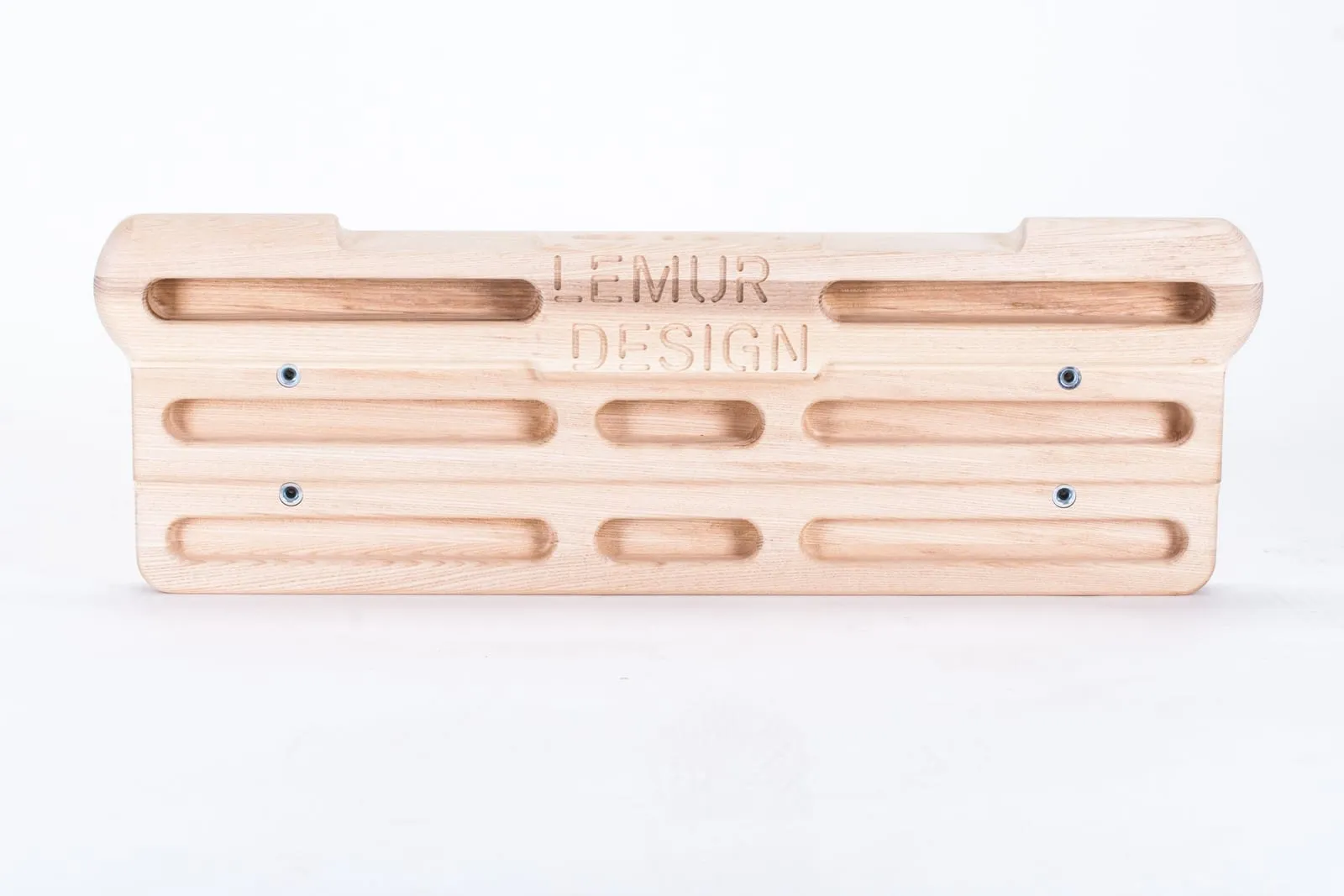
| Equipment | A hangboard with a comfortable 20 to 25 mm edge, and a way to take weight off: feet on a chair, a pulley with a counterweight, or a force plate so you can pull from the floor |
| Grips | Open hand and half crimp. Leave full crimps, monos and pockets for later |
| Frequency | 2 sessions a week, at least 48 h apart, at the start of a climbing session after a full warm-up |
| Weeks 1 to 2 | Learn the position: 6 hangs of 7 s, 3 min rest, half on open hand, half on half crimp. Feet assisted, about 50 to 60% of body weight, easy |
| Weeks 3 to 4 | 6 hangs of 10 s, 3 min rest, at about 70% of body weight; finish every hang with a few seconds in reserve |
| Weeks 5 to 6 | 6 hangs of 10 s, 3 min rest. Remove assistance gradually; still 3 or more seconds in reserve |
| Weeks 7 to 8 | 6 hangs of 10 s, 3 min rest, at body weight if it is comfortable; otherwise stay assisted |
| After week 8 | Test your max and move to max hangs or repeaters. In % of max, raise the load by no more than about 5% of max a week (coaching practice) |
| Form | Arms straight but shoulders engaged, not hanging in the joints. Fingers stay in the same position for the whole hang. Step off or unload smoothly; do not drop onto your fingers |
| When to stop | A grip that opens or fingers that slide: the load is too high. Sharp pain, a pop, or pain at the base of a finger still there the next day: stop the session and back off for a few days; if it persists, see a physiotherapist |
How these sessions fit into a full week of climbing is in hangboard routine.
Why this plan?
It is ours, informed by common coaching practice (Lattice Training, Eva López, Eric Hörst) and by the small weekly load increases of a 2021 trial in intermediate-to-advanced climbers, where adding 1.25 kg a week beat climbing alone by a small margin. It is not that trial’s protocol; max hangs covers the trial.
What if full hangs feel like too much?
Start with no-hangs: your feet stay on the floor and you pull to a set fraction of your strength, around 40%, for 10 seconds at a time. They are easy to scale and hard to overdo, and you can build the habit of loading your fingers daily before adding heavier hangs.
Do this in Entralpi
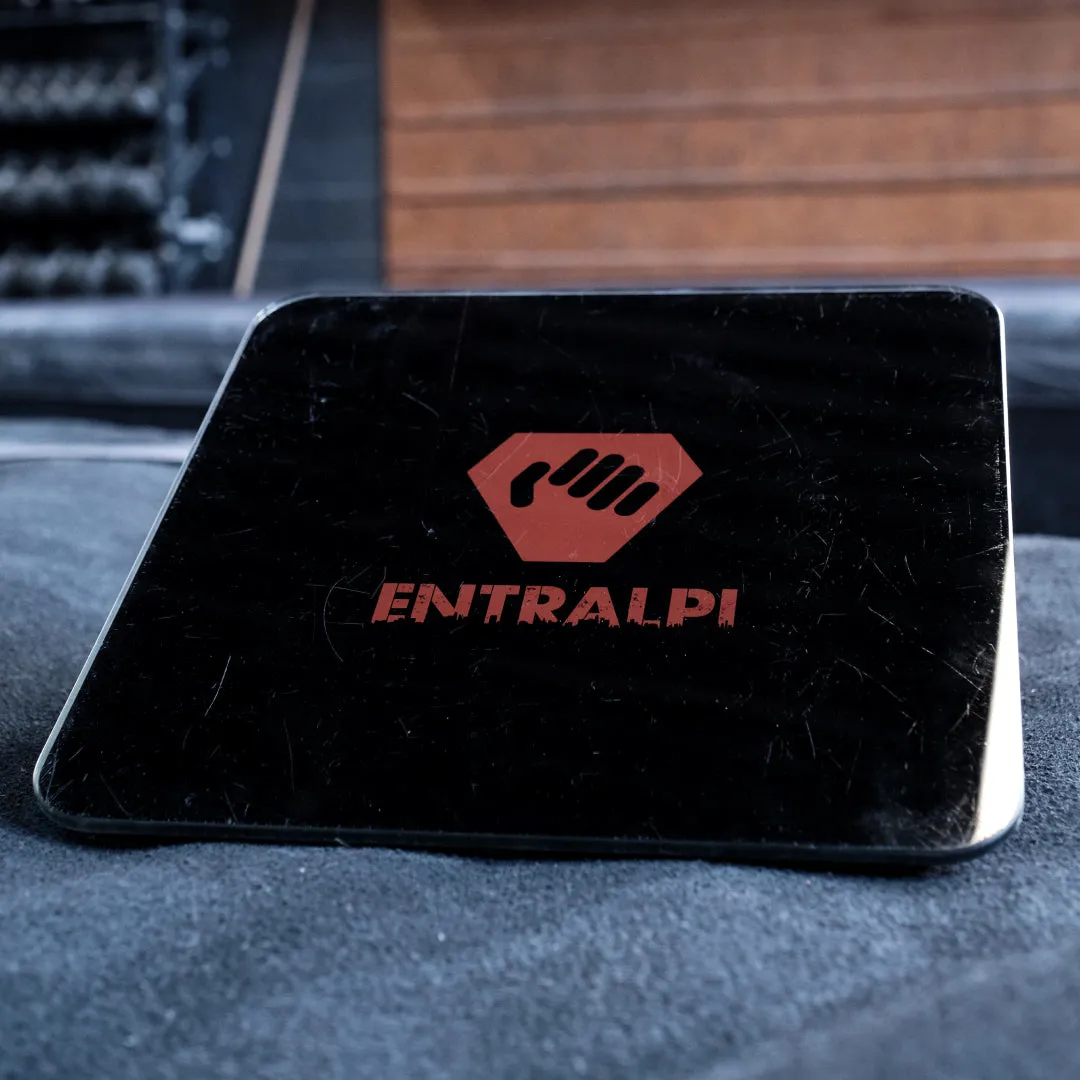
The hardest thing for a beginner is knowing how much weight is on the fingers when the feet help. On the Entralpi plate, you stand under your hangboard and see how many kilograms your fingers hold, so “about 60% of body weight” becomes a number on the screen. The max strength test measures your max (Take a test). Keep it with one tap at the end of the test, or type it in Settings (Profile, then Settings, under Physical Profile, Max strength), then choose a workout from the Train tab or build your own with loads in % max. Without the plate, the timer runs the session but measures no force.
Sources
- Berta P, et al. (2025). Validity and normative scores of finger flexor strength and endurance tests. Journal of Sports Sciences, 43(3).
- Mundry S, et al. (2021). Hangboard training in advanced climbers: a randomized controlled trial. Scientific Reports.
- Schöffl V, et al. (2022). Evaluation of a diagnostic-therapeutic algorithm for finger epiphyseal growth plate stress injuries in adolescent climbers. American Journal of Sports Medicine.
Was this helpful?
Thank you. It tells us which articles to improve.
Sorry this did not answer your question. Write to us if you need an answer, or try the search above.
Thank you. It helps us improve this page.