Partial Hangs: Hangboard With Feet on Floor
A partial hang is a hang with your feet on the floor, so part of your weight stays off your fingers. It lets you set and change the load precisely, which suits beginners and light work. I found no study showing it beats hanging with your feet off the floor.
When I wrote this in 2020 I called the method better suited to climbing than conventional dead hangs. I would put it more carefully now: it isolates climbing movements and needs almost no equipment, but the claim that it transfers better is my opinion, not a finding.
Why do climbers train with their feet on the ground?
Body tension is critical in climbing. When your feet come off, you’re either holding a dyno or you’re done. Partial hangs build the habit of holding tension between the tips of your toes and the tips of your fingers while also loading the fingers. To me that feels closer to climbing. It is a reason I like the method, and I haven’t seen it tested.
How do partial hangs let you adjust intensity?
Keeping your feet on the ground is what lets you dial in the load you’re aiming for. When the load you’re putting through the holds is in front of you as a number, you can adjust directly and precisely. That takes a force plate or a scale under your feet; without one you are guessing.
You can measure progress exactly, back the load off to avoid discomfort, or drop the intensity mid-exercise so you can keep going once you’d otherwise have to stop. I used to add that marginal gains in strength can have a large effect. I can’t support that, so I’ve removed it.
How low can the load be and still help? The best evidence is indirect. A retrospective study of 526 climbers who logged their training compared low-intensity hangs done with feet on the floor at a “light strain” of about 40% of max (the “Abrahangs” protocol, called no-hangs in this library) with other approaches. It found a 2.5% strength-to-weight gain, against 3.2% for max hangs and 5.8% for both together. It was not a randomised trial, the Abrahangs-only gain was not statistically different from climbing alone, and one author developed the protocol (Gilmore et al., 2024). See No-hangs for the protocol.
Which finger-strength qualities can you train this way?
My goal in training is still to climb better: more boulders and routes within reach, more out of a trip, or simply climbing longer without fading. Goals that vague don’t translate into a training plan on their own.
A little analysis pulls out specific aspects of finger strength you can train individually:
- Maximum strength (see Max hangs)
- Anaerobic endurance
- Aerobic endurance
- Warm-up
- Dynamic catches
- Monos
- Daily routine
- Finger curls
- Shoulder engagement
Partial hangs suit a lot of this varied training. It’s easy to get lost in the range of exercises available. A simple practice is to keep the focus on one or two of these for a few weeks, measure your progress, and change focus when it stalls. That focus-measure-change approach is my practice.
One limit: for maximal strength work you need the load high enough, and with your feet on the floor you remove part of your weight. At the top end, many climbers need to take their feet off. Maximal hangs are the best-studied way to build strength; see Finger strength for the evidence.
Who are partial hangs for?
Partial hangs are simple exercises that suit climbers who are new to training, and their intensity, form and specificity can be adjusted to anyone’s needs. If a finger hurts, stop: pain ends the session, and if it persists see a physiotherapist.
Training is more fun when you play with it.
Do this in Entralpi
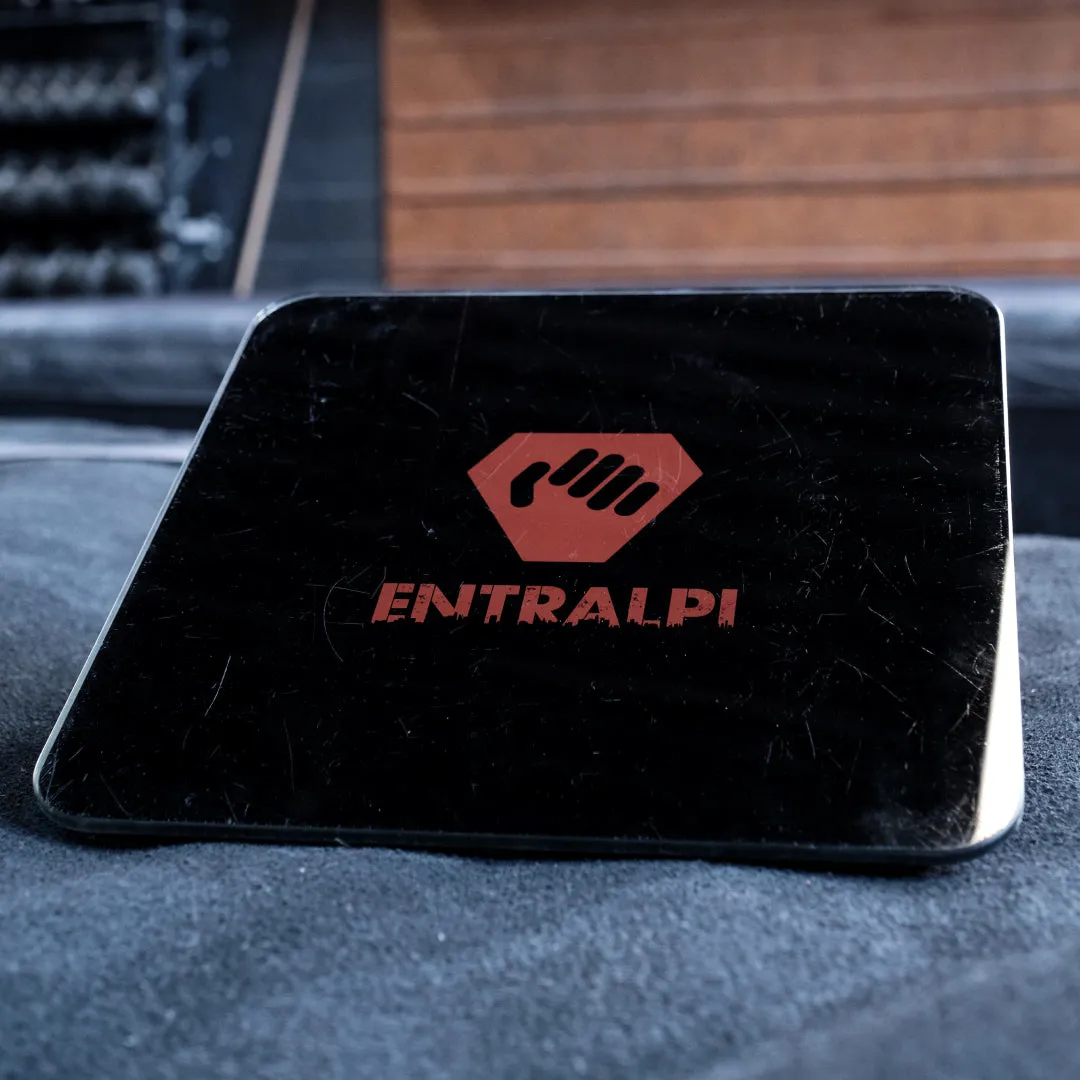
The max strength test measures your max; type it in Settings (Profile, then Settings, under Physical Profile, Max strength), and a load in % max becomes kilograms. Then start a workout from the Train tab or build your own at the percentage you chose. The plate shows the force through your fingers live, which is what makes a partial hang precise. Without the plate, the timer runs the hang and rest times and you choose the load by feel.
Sources
- Gilmore NK, Klimek P, Abrahamsson E, Baar K (2024). Effects of different loading programs on finger strength in rock climbers. Sports Medicine - Open.