Daily Finger Routine for Climbers: 3 Minutes
Updated 4 min read Plan your training Félix Bourassa-Moreau
On this page
Do three minutes of very light hangs, at 20 to 30% of your open-hand maximum, on rest days or as a morning warm-up. It should feel like nothing. It is a habit, a warm-up and a way to calibrate your effort, not tendon training: tendons adapt to high loads, so keep your hard sessions.
What is the daily routine?
It is the opposite of a hard session. In my experience, gymnasts and yogis practise almost every day and their bodies adapt, while climbers who try the same approach tend to end up overtrained and tired. The difference is intensity, not frequency, so this routine keeps the intensity very low and the time to three minutes.
How do you do it?
On a full pad edge, both hands, feet on the ground.
| # | Grip | Work | Intensity |
|---|---|---|---|
| 1 | All fingers, open hand | 4 × (10s on / 5s off) | 20–30% of your open-hand max |
| 2 | Single finger, half crimp | 1 × (10s on) per finger | 10–20% of that finger’s max |
| 3 | Single finger, open hand | 1 × (10s on) per finger | 10–20% of that finger’s max |
| 4 | All fingers, open hand | 4 × (10s on / 5s off) | 20–30% of your open-hand max |
The single-finger loads are a share of what that finger can do on its own, not of your four-finger max. One finger is not a quarter of four.
Without a force plate, forget the percentages and use the feel test: at the end of the three minutes you should feel like you did nothing. No pump, no shake, no soreness the next morning. If you feel any of those, you are too high. This is the one rule that matters; the numbers are a faster way to find the same place.
Pain in a finger ends the session, and if it lasts, see a physiotherapist.
Why does it work, and how sure are we?
It works as a habit and a warm-up. What it does for tendons is unproven.
Short and frequent suits connective tissue, in the lab. Keith Baar’s work on engineered ligaments suggests short bouts of loading separated by long rests; Daily low-intensity hangs explains that rationale and its limits. It does not show that three minutes at 20 to 30% of max builds tendon. Human tendon studies point the other way on intensity: a 2015 meta-analysis found that tendon stiffness adaptation depends significantly on loading intensity (Bohm et al.), and a 2024 trial used loads at about 90% of maximum to change the Achilles tendon (Tsai et al.). So treat this routine as a floor. Heavier work belongs in your hard sessions, such as max hangs, and How often should you hangboard? shows where they fit.
Light daily hangs have one study in climbers. In 2024 app data, frequent low-intensity hangs (“Abrahangs”) gave a small strength gain that was not significant against climbing alone (Gilmore et al., 2024); Daily low-intensity hangs goes through the study.
Don’t count on it to recover you. I used to say this routine speeds recovery by bringing blood and nutrients to the fingers. I can’t support that: in the one trial I found on recovery between exhausting finger-flexor efforts, easy hanging or easy climbing did worse than walking (Krupková et al., 2024). Do it only if it leaves you feeling fresh. On climbing days it works as a morning warm-up before the warm-up routine.
The habit is the point. Very short workouts are easy to keep, and the value is in the accumulation: one session does nothing, a long streak is what you notice. Doing this daily also gave me a calibrated sense of how hard I pull on holds, which carried over to the wall. That is my observation, not a measured result.
Who is it for, and who should not?
It suits climbers who want a daily habit or a morning warm-up that costs nothing. When you want more, aerobic endurance on the hangboard is the next step up in duration, still at low intensity.
Go carefully with the single-finger blocks. Pulling on a hold with one finger is tricky and can injure someone unprepared for it, and single-finger tissue adapts more slowly than you will want it to. Daily low-intensity work is what got my own hands used to loading individual fingers, and it is the part of this routine I would skip last; no study has tested that. Start at the bottom of the range and stay well under the loads in Training for monos, which covers the injury risk.
Do this in Entralpi
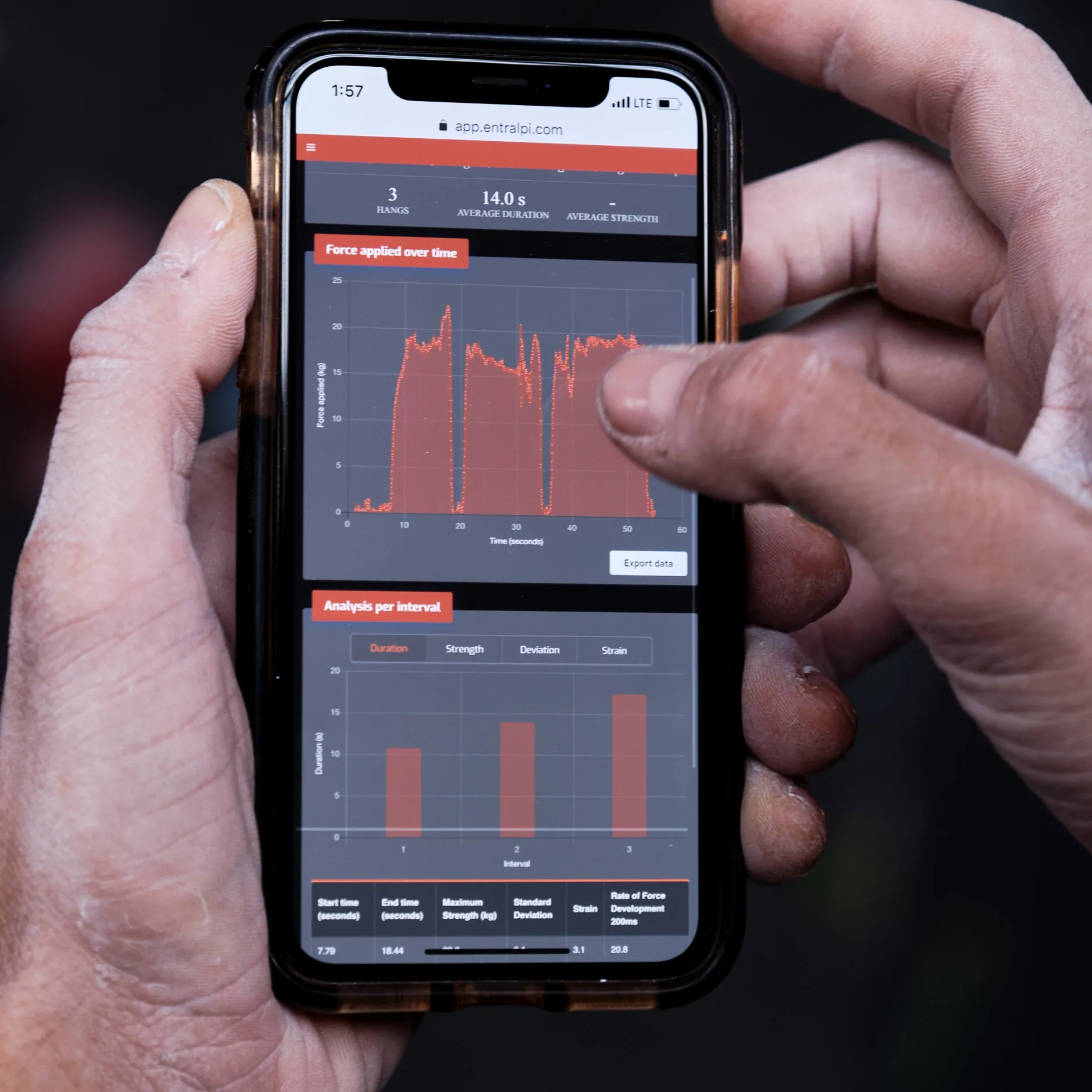
The max strength test measures your max; keep it with one tap at the end of the test, or type it in Settings (Profile, then Settings, under Physical Profile, Max strength), and a load in % max becomes kilograms. Workouts on one finger use your finger strength test for that finger by themselves. Then build your own workout with the four blocks above, or start one from the Train tab. Without the plate, the timer runs the 10 and 5 second intervals and you use the feel test.
Sources
- Baar K (2017). Minimizing injury and maximizing return to play: lessons from engineered ligaments. Sports Medicine.
- Bohm S, Mersmann F, Arampatzis A (2015). Human tendon adaptation in response to mechanical loading: a systematic review and meta-analysis of exercise intervention studies on healthy adults. Sports Medicine - Open.
- Tsai MS, et al. (2024). Effect of the temporal coordination and volume of cyclic mechanical loading on human Achilles tendon adaptation in men. Scientific Reports.
- Gilmore NK, Klimek P, Abrahamsson E, Baar K (2024). Effects of different loading programs on finger strength in rock climbers. Sports Medicine - Open.
- Krupková D, Tufano JJ, Baláš J (2024). Optimizing active recovery strategies for finger flexor fatigue. Frontiers in Sports and Active Living.
Was this helpful?
Thank you. It tells us which articles to improve.
Sorry this did not answer your question. Write to us if you need an answer, or try the search above.
Thank you. It helps us improve this page.