Hangboard Training at Home: A Weekly Plan
Updated 5 min read Plan your training Julien Corneau
On this page
To train your fingers at home, split your week by what you want to train and set each hang as a share of your maximum: heavy and short for strength, repeaters for strength-endurance, light and long for endurance. Test your max first. In the studies, hard finger sessions were done about twice a week.
I used this plan in March 2020, when gyms were shut. I have since checked each part against the research and say where it is only my experience.
What does training at home mean here?
Finger work on a board, with the load set as a share of your maximum. Find the maximum force you can apply on a given hold with a given grip. The percentage and the duration of each effort then decide which training quality the session aims at: strength, contact strength, resistance or endurance. These are qualities, not energy systems; only the endurance work maps loosely onto aerobic metabolism.
Keep the finger work simple, in line with the cycle you are in and the goals ahead of you, and vary the routine from time to time. Add complementary strength work that is as specific as possible to your objectives. Guided workouts online help hold general fitness, but try to recreate positions close to the ones climbing demands.
How do you do it?
Here is the finger work I did. The hang times suit my goals and my style of climbing, which is fairly fast.
| Quality | Load | Work and rest | When |
|---|---|---|---|
| Strength | Up to 90% of max | About 7 s per hang, at least 2 min rest | Short sessions, about twice a week |
| Contact strength | Maximal, reaching high force very fast | Several 1 s contractions a few seconds apart, then at least 2 min rest | Right after the strength work |
| Resistance | About 65 to 75% of max | 6 × (7 s on / 3 s off), about 6 sets, until performance drops and you have a good pump | Once a week |
| Endurance | About 30% of max | 10 s on / 5 s off for 15 min | Almost every day, sometimes several times a day |
With no climbing, my week looked like this:
| Day | Session |
|---|---|
| Saturday | Strength |
| Sunday | Active rest (endurance) |
| Monday | Resistance |
| Tuesday | Active rest (endurance) |
| Wednesday | Strength |
| Thursday | Active rest (endurance) |
| Friday | Full rest |
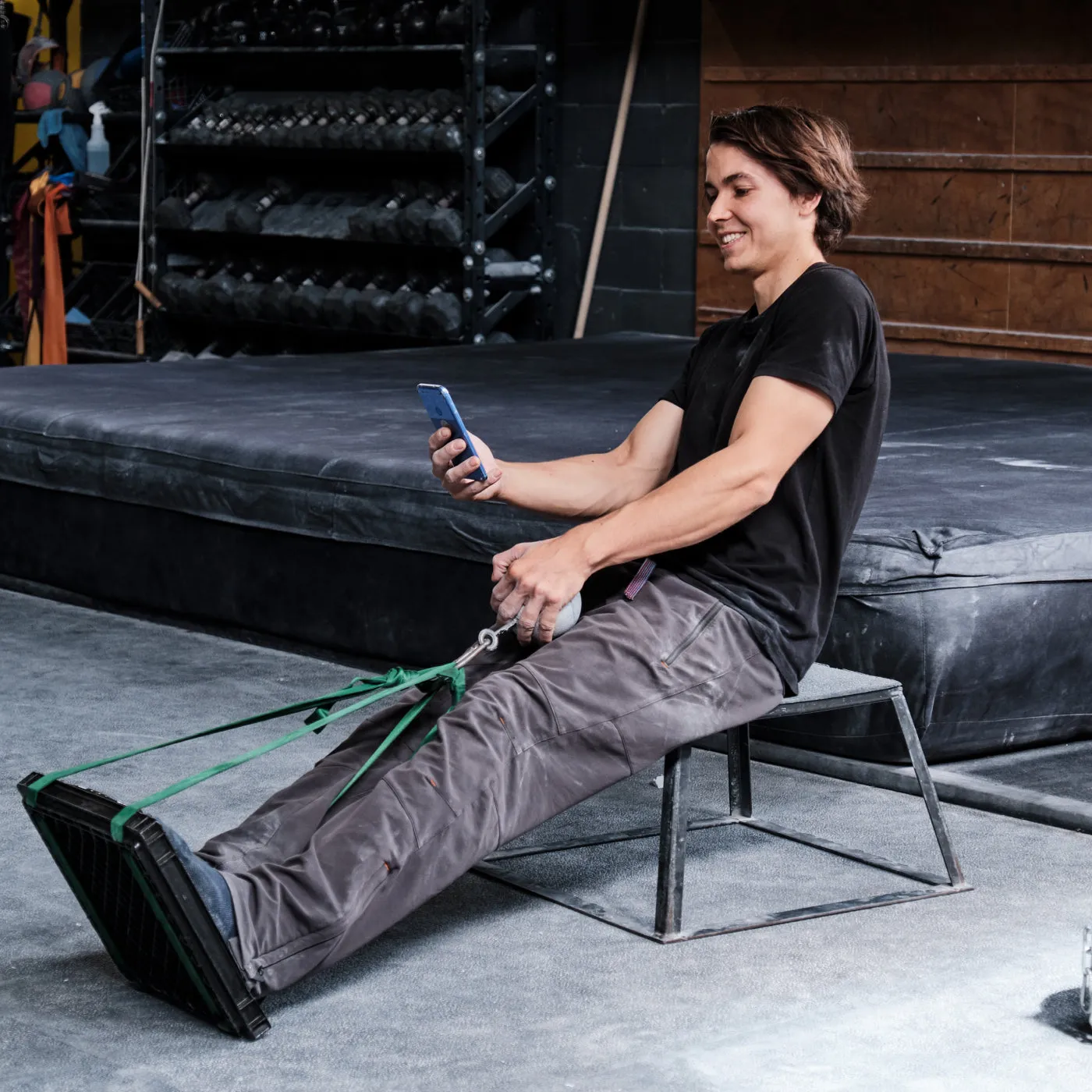
The endurance work suits a portable hangboard. In 2020 I used a Digitclimbing Yubiboard fixed to the Entralpi plate in a seated position, which avoids overtiring the shoulders with too much weekly hanging volume in the same position.
Why does it work, and how sure are we?
Each block sits in a range the research supports, but the plan as a whole is one climber’s experience, not a tested program. Training this way is supported in general: a 2023 meta-analysis found that finger-flexor resistance training beat climbing alone for finger strength, rate of force development and forearm endurance (Stien et al.).
- Strength. In a randomised trial of 54 experienced climbers, hanging at 100% of max, or intermittently at 80%, twice a week for four weeks improved maximal finger strength (Devise et al., 2022). Max hangs covers how strength training works.
- Contact strength. In a small study of 14 elite climbers, four weeks of hangs on small holds, twice a week, raised the rate of force development in the first 200 ms by about 27 to 32% (Levernier and Laffaye, 2019). See rate of force development.
- Resistance. Intensity decides what you train: in the 2022 trial, intermittent hangs at 80% of max improved both strength and endurance, while 60% improved endurance without a significant strength gain (Devise et al.). Repeaters covers the format. I rarely used it in normal times, but in lockdown it stood in reasonably well for my weekly route session.
- Endurance. About 30% of max is aerobic-base work, below the average critical force of climbers, about 41% of max (Giles et al., 2019); finger endurance training explains the zones. I felt it helped me shake out on holds, but no trial has tested this exact routine, and no study has shown that daily practice is needed. Light daily hangs gave a small gain that was not significant against climbing alone in a 2024 study (Gilmore et al., 2024); see daily low-intensity hangs.
Who is it for, and who should not?
It suits climbers who cannot get to a wall and have tested their max. Contact strength is for climbers with solid hanging experience: fast, maximal loading is demanding on the fingers, so build a base first.
- Don’t swap a large climbing volume for hangs. If your body isn’t used to that kind of effort, don’t grind out endless sessions on your board. Build up the endurance frequency over several weeks.
- Count your climbing if you climb. This week covers finger training only; How often should you hangboard? shows how to fit the two.
- Pain in a finger stops the session. If it doesn’t go away, see a physiotherapist.
Do this in Entralpi
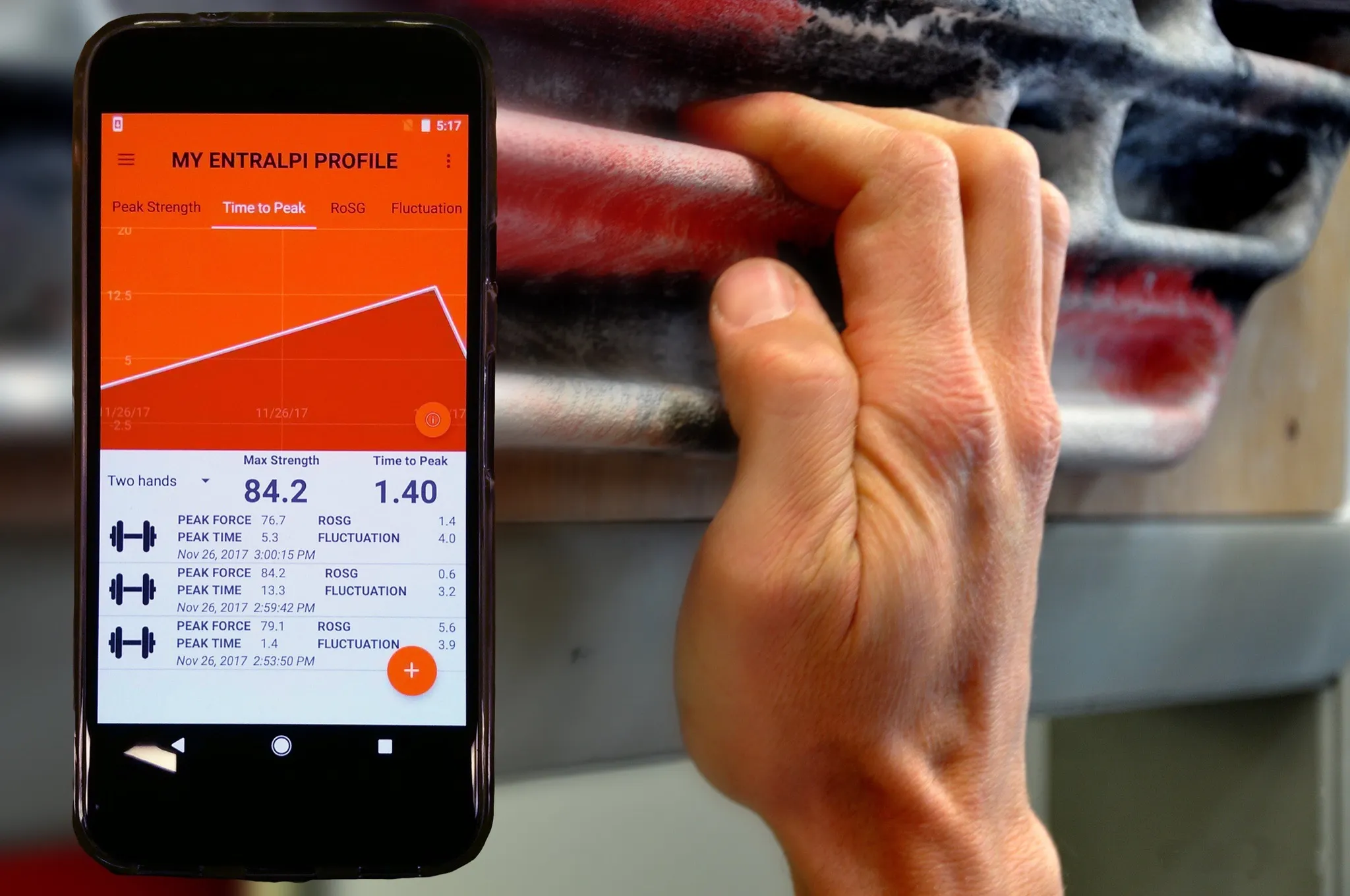
The max strength test measures your max; keep it with one tap at the end of the test, or type it in Settings (Profile, then Settings, under Physical Profile, Max strength), and a load in % max becomes kilograms. Then start a workout from the Train tab or build your own with the hang times and loads you chose. Without the plate, the timer runs the intervals and you pick the load by feel.
Sources
- Stien N, et al. (2023). Effects of climbing- and resistance-training on climbing-specific performance: a systematic review and meta-analysis. Biology of Sport.
- Devise M, Lechaptois C, Berton E, Vigouroux L (2022). Effects of different hangboard training intensities on finger grip strength, stamina, and endurance. Frontiers in Sports and Active Living.
- Levernier G, Laffaye G (2019). Four weeks of finger grip training increases the rate of force development and the maximal force in elite and top world-ranking climbers. Journal of Strength and Conditioning Research, 33(9).
- Giles D, et al. (2019). The determination of finger-flexor critical force in rock climbers. International Journal of Sports Physiology and Performance.
- Gilmore NK, Klimek P, Abrahamsson E, Baar K (2024). Effects of different loading programs on finger strength in rock climbers. Sports Medicine - Open.
Was this helpful?
Thank you. It tells us which articles to improve.
Sorry this did not answer your question. Write to us if you need an answer, or try the search above.
Thank you. It helps us improve this page.